

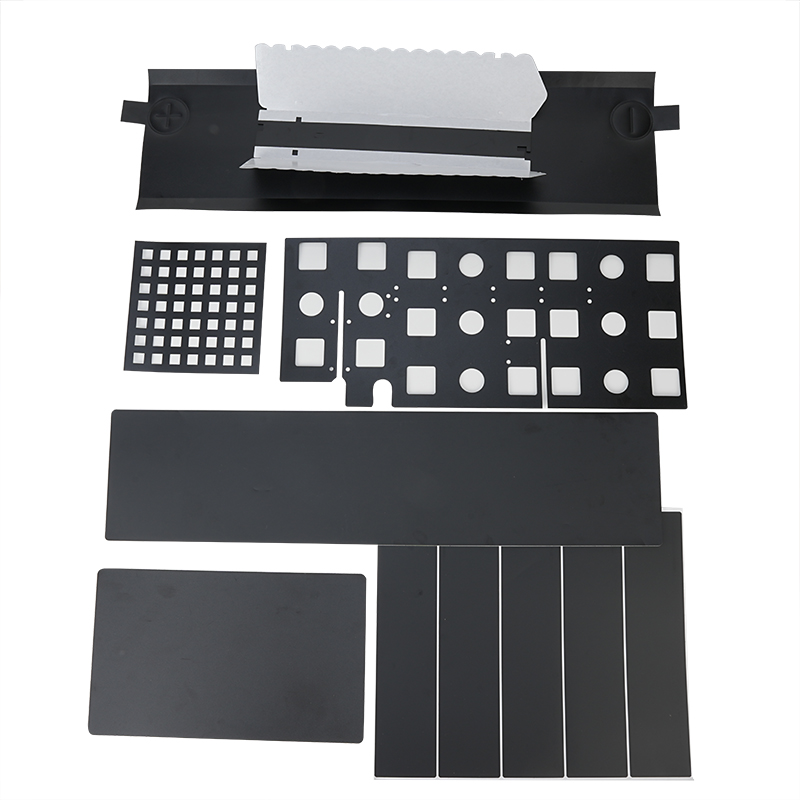
Electrical-Insulation Black Matte PC Mylar Sheet is a high-performance polycarbonate film designed for electrical insulation, mechanical protection, component separation, and industrial converting applications. The material combines the toughness of polycarbonate with a matte surface appearance, dimensional stability, formability, and flame-retardant options, making it suitable for demanding electrical and electronic assemblies.
Black matte PC film is particularly useful where a combination of electrical isolation, mechanical durability, controlled surface friction, and professional appearance is required. Depending on the selected material grade and construction, the film can be processed into flat insulation sheets, die-cut parts, formed covers, barriers, protective liners, and laminated structures.
The material can be used in power supplies, disk drives, bus bars, televisions, monitors, printed circuit boards, commercial electronic equipment, electrical control systems, industrial machinery, and other applications in which thin, lightweight insulation is needed.
A major advantage of polycarbonate film is its ability to provide a useful balance between flexibility and mechanical strength. Compared with many more brittle plastic films, PC can better tolerate bending, handling, forming, and impact. This makes it suitable for components that must be installed around corners, openings, mounting structures, or irregular electronic assemblies.
Black matte PC film can also be combined with metal foil. In this type of laminated construction, the PC film can provide electrical insulation while the conductive metal layer can contribute to electromagnetic interference and radio-frequency interference shielding. The final performance depends on the complete laminate construction, grounding method, frequency range, and equipment design.
1. What Is Black Matte PC Mylar Sheet?
Black matte PC Mylar sheet is a common industrial description for a thin polycarbonate insulation film with a matte black surface. Strictly speaking, PC film and traditional PET Mylar film are different polymer materials. In industrial product descriptions, however, the term “Mylar sheet” is sometimes used broadly for thin plastic electrical insulation films.
The substrate in this product is polycarbonate rather than polyethylene terephthalate.
Polycarbonate is an engineering thermoplastic known for its toughness, impact resistance, dimensional stability, optical properties, and processing versatility. When formulated for electrical applications, it can provide a useful combination of dielectric insulation and mechanical performance.
The matte surface gives the film a low-gloss appearance and can provide a different frictional characteristic from a highly polished surface.
For industrial applications, black matte PC film may be supplied as:
Flat sheets
Rolls
Die-cut components
Adhesive-backed parts
Laminated constructions
Formed insulation components
Protective covers
Custom electrical barriers
2. Important Difference Between PC and PET Mylar
The distinction between PC and PET is important when selecting electrical insulation film.
Traditional PET Mylar-type film is widely used for electrical insulation because of its good dielectric properties, dimensional stability, chemical resistance, and cost effectiveness. PET is generally suitable for many conventional insulation applications.
Polycarbonate offers a different performance profile.
PC is particularly attractive when the application requires:
Higher impact resistance
Better crack resistance
Improved toughness
Greater forming capability
More demanding mechanical handling
Resistance to sudden impact
Complex die-cut or formed structures
For applications exposed to elevated temperatures, the actual temperature rating must always be confirmed for the specific grade and thickness. A general material description should not be treated as a guaranteed operating temperature.
The distinction is especially important when an insulation component must be bent, formed, clipped, or installed around a structural feature.
3. Product Features
This film boasts excellent formability and mechanical properties, favorable dimensional stability at elevated temperatures, and high flame-retardant rating. It is well-suited for insulation applications in power supplies, disk drives, bus bars, TVs / monitors, PCBs and commercial equipment. When laminated with metal foil, it can serve for insulation and EMI/RFI shielding.
The major product characteristics can be summarized as follows:
| Feature | Functional Value |
|---|---|
| Polycarbonate substrate | Provides a strong and versatile electrical insulation base |
| Black matte surface | Offers low-gloss appearance and useful surface friction |
| Excellent formability | Supports bending, forming, and customized structures |
| Mechanical strength | Helps withstand handling and assembly stress |
| Dimensional stability | Supports consistent component geometry |
| Flame-retardant options | Suitable for electrical designs requiring improved fire performance |
| Die-cut compatibility | Allows custom insulation shapes |
| Adhesive compatibility | Can be integrated into self-adhesive constructions |
| Metal foil lamination | Can combine insulation with EMI/RFI shielding functions |
| Lightweight construction | Helps reduce bulk compared with rigid insulation parts |
4. Polycarbonate Film Advantages
The following functional advantages represent common application areas for polycarbonate film and have been incorporated from the supplied reference material:
Pasting, fixing, conductive shielding, and electrical insulation.
Fire resistance, flame-retardant protection, shock buffering, dust protection, and anti-skid functions.
Backlighting applications, elevated-temperature environments, corrosion protection, sealing, and component protection.
Spraying protection, electrical insulation, noise-control applications, and filtering structures.
Professional precision die processing can convert the film into a wide variety of custom shapes.
These functions demonstrate why PC film can serve as more than a simple electrical barrier. In practical engineering, the material may become part of a multifunctional component.
5. Electrical Insulation Function
Electrical insulation is one of the most important uses of black matte PC film.
An insulation film can physically separate conductive components from:
Metal housings
Bus bars
PCB supports
Fasteners
Electrical terminals
Structural Brackets
Heat sinks
Internal frames
Other conductive surfaces
The purpose is to reduce the possibility of unintended electrical contact.
The film itself must be selected according to the electrical requirements of the application. Important considerations include dielectric strength, insulation resistance, film thickness, operating temperature, environmental exposure, and mechanical integrity.
6. Dielectric Protection
A suitable PC film can act as a dielectric barrier between electrically conductive components.
This is particularly useful in compact assemblies where components are positioned close together.
A thin film can occupy relatively little space while providing a defined insulating layer.
In high-voltage designs, however, insulation film should not be considered separately from the complete electrical architecture. Creepage, clearance, voltage stress, contamination, humidity, and the shape of conductive components must all be considered.
7. Black Matte Surface
The black matte surface is one of the defining characteristics of this material.
Unlike a highly glossy surface, matte PC film has a subdued visual appearance.
This can be advantageous for:
Internal electrical components
Electronic housings
Display equipment
Commercial equipment
Industrial control panels
Protective liners
Decorative technical components
Black also provides light-blocking characteristics that can be useful in certain electronic assemblies.
8. Surface Friction and Anti-Skid Function
The supplied reference identifies anti-skid performance as one of the potential functional advantages of polycarbonate film.
A matte or textured surface can provide a different coefficient of friction compared with a smooth surface.
This can be useful when the film is used as:
A protective liner
A positioning layer
A component separator
A surface protection sheet
A friction-supporting barrier
The actual friction performance depends on surface texture, mating material, pressure, temperature, contamination, and other conditions.
9. Mechanical Strength
Polycarbonate is recognized for its toughness.
For electrical insulation applications, mechanical strength matters because the film may be:
Cut
Bent
Folded
Stamped
Formed
Installed manually
Inserted into narrow spaces
Compressed between components
A mechanically robust film is less likely to crack during normal handling than a more brittle material.
This characteristic can improve manufacturing reliability.
10. Impact Resistance
Impact resistance is another important advantage of PC.
Electrical equipment may experience accidental impact during:
Assembly
Transportation
Maintenance
Equipment installation
Mechanical vibration
Service operations
A tough insulation film can provide an additional protective layer.
It may also function as a shock-buffering component where the mechanical design permits.
11. Crack Resistance
Cracking can compromise the protective function of an insulation component.
PC film can offer useful crack resistance because of its toughness and flexibility.
This is particularly valuable when the film is formed around edges or contains:
Holes
Slots
Narrow sections
Corners
Cutouts
Mounting openings
Correct geometry remains important because even tough plastics can fail if sharp corners and excessive stress concentrations are introduced.
12. Formability
Formability is a major reason to choose PC film for customized electrical applications.
A formable grade can be processed into structures that are not completely flat.
Potential configurations include:
Folded barriers
Wrapped insulation
Curved covers
Edge protectors
Protective shields
Three-dimensional separators
This allows engineers to create insulation components that follow the physical structure of equipment.
13. Formed Electrical Insulation
A formed PC component can cover multiple surfaces using one piece of material.
For example, a single part may cover:
A horizontal surface
A vertical edge
A corner
A mounting region
This can reduce the number of individual insulation pieces.
It may also improve assembly consistency.
14. Dimensional Stability
Dimensional stability is important in electrical equipment because insulation components often have precisely defined boundaries.
A component that changes shape excessively during operation may interfere with:
Connectors
Wires
Terminals
Fasteners
Heat sinks
Other insulation components
A dimensionally stable PC film can help maintain the intended geometry over the expected operating range.
The actual thermal dimensional stability should always be verified against the selected grade.
15. Elevated-Temperature Applications
The supplied product description highlights favorable dimensional stability at elevated temperatures.
This makes the material relevant to equipment where internal temperatures rise during operation.
Potential applications include:
Power supplies
Industrial electronics
Motor controllers
Electrical control equipment
Commercial equipment
Electronic assemblies
Temperature suitability depends on the specific PC grade, thickness, stress level, exposure time, and surrounding materials.
16. Flame-Retardant Performance
Flame-retardant PC grades are commonly considered for electrical and electronic applications where improved resistance to ignition and flame propagation is required.
A flame-retardant formulation can be especially valuable in:
Power supplies
Electrical control equipment
Commercial electronics
PCB assemblies
Power conversion equipment
Industrial electrical products
A specific flame classification must always be associated with the exact material grade and test thickness.
17. Flame Retardancy and System Safety
Flame-retardant film contributes to the material-level fire-safety design.
It does not independently determine the fire safety of an entire electronic product.
System-level fire behavior can also depend on:
Electrical protection
Component spacing
Heat generation
Enclosure design
Ventilation
Wiring
Power density
Thermal management
Adjacent materials
Therefore, flame-retardant PC film should be evaluated as one element of the complete safety architecture.
18. Dust Protection
The supplied reference also identifies dustproof performance as a potential application.
A PC film can function as a physical barrier over openings or sensitive surfaces.
Possible uses include:
Electronic enclosures
Control panels
Equipment covers
PCB protection
Internal barriers
Component liners
When combined with an adhesive layer or appropriate mechanical structure, the film can contribute to sealing and contamination control.
19. Sealing Applications
Thin PC film can be incorporated into sealing structures when the application requires a rigid or semi-rigid polymer barrier.
Potential functions include:
Closing openings
Protecting component interfaces
Separating internal regions
Supporting protective layers
Providing a backing layer for sealing materials
PC film should not automatically be treated as a replacement for an elastomeric gasket. Where compression sealing is required, the complete sealing structure must be designed accordingly.
20. Corrosion Protection
Polycarbonate film can also act as a physical separation layer between components.
For example, it can isolate a metal component from another surface or protect a sensitive electronic region from environmental contact.
The actual chemical resistance depends on the specific PC formulation and exposure environment.
Applications involving aggressive chemicals should always be validated before production.
21. Chemical Resistance
Electrical equipment may encounter:
Oils
Cleaning agents
Humidity
Industrial chemicals
Solvents
Lubricants
Processing residues
PC is compatible with many environments but is not universally resistant to every chemical.
A material compatibility test is recommended when the film will experience prolonged exposure.
22. Power Supply Insulation
Power supplies are one of the key application areas for black matte PC insulation film.
A switching power supply can contain:
Transformers
Inductors
Capacitors
Heat sinks
PCB assemblies
Metal brackets
Terminals
High-voltage areas
Insulation film can be used to separate conductive structures and protect selected components.
23. PCB Insulation
Printed circuit boards may be installed close to metal housings or structural components.
A thin PC film can be used as a protective barrier between the PCB and surrounding structures.
Custom cutouts can accommodate:
Screws
Connectors
Wiring
Mounting posts
Switches
Heat sinks
This enables the insulation layer to match the PCB architecture.
24. Bus Bar Insulation
Bus bars carry electrical current and may be positioned near metal structures.
PC film can be converted into barriers, covers, separators, and localized insulation components around bus bars.
A custom shape can provide openings for bolts and connection points.
The insulation design should preserve the required electrical spacing.
25. Disk Drive Applications
The supplied product description specifically identifies disk drives as an application area.
Disk-drive assemblies contain precision mechanical and electronic components that may require electrical separation and protection.
Thin PC film can be used for:
Internal insulation
Component separation
Protective barriers
Cable routing protection
Mechanical interface protection
The exact design depends on the equipment architecture.
26. Television and Monitor Applications
Televisions and monitors contain:
PCBs
Metal frames
Display modules
Power boards
Connectors
Wiring
Heat-producing components
PC insulation film can be used around selected internal structures.
Black matte material can also provide a visually compatible appearance inside dark-colored electronic assemblies.
27. Commercial Equipment
Commercial electronic equipment often requires reliable insulation in compact internal assemblies.
Examples include:
Payment equipment
Office electronics
Display systems
Control equipment
Professional audiovisual equipment
Commercial power electronics
Custom PC film can provide targeted insulation without adding significant structural bulk.
28. Industrial Equipment
Industrial machinery can combine electrical, mechanical, and thermal requirements.
PC film can serve as:
An electrical barrier
Protective liner
Component separator
Cable protection layer
Dust barrier
Shock-buffering layer
The selected grade should match the industrial environment.
29. EMI and RFI Shielding
When PC film is laminated with metal foil, the construction can combine insulation and electromagnetic shielding functions.
The polymer layer can electrically isolate the conductive foil from the protected component.
The metal foil can provide a conductive shielding layer.
This construction is useful where both electrical isolation and EMI/RFI control are required.
30. How Metal-Foil Lamination Works
A simplified construction may consist of:
PC insulation film + conductive metal foil
The PC layer provides dielectric separation.
The conductive foil can interact with electromagnetic fields.
For effective shielding, the overall design must also consider:
Shield continuity
Grounding
Connection points
Frequency range
Apertures
Cable entry
Enclosure geometry
Shielding performance cannot be determined from the PC film alone.
31. EMI Shielding Applications
Potential applications include:
Power electronics
Communication equipment
Control systems
Industrial electronics
Display equipment
Electronic enclosures
The final shielding effectiveness depends on the conductive layer and system design.
32. RFI Protection
Radio-frequency interference can affect sensitive electronic circuits.
A conductive foil laminate can provide a barrier against certain electromagnetic fields.
PC film can electrically separate the shielding foil from the electronic component.
This makes the material useful in multifunctional insulation constructions.
33. Conductive Shielding Versus Electrical Insulation
These two functions may appear contradictory, but they can coexist in a multilayer construction.
The conductive foil provides the shielding function.
The PC film provides electrical isolation.
This combination is particularly useful when the conductive shielding layer must be located close to sensitive electronics without creating an unwanted electrical contact.
34. Backlighting Applications
The supplied reference also identifies backlighting as a potential application.
Black or specially processed PC films can be incorporated into optical or electronic assemblies where controlled light transmission or blocking is required.
The actual optical behavior depends on:
Color
Surface finish
Thickness
Transparency
Light source
Printing or coating
Application geometry
Black PC is generally selected where light blocking is desirable rather than maximum light transmission.
35. Noise-Control Applications
The supplied reference includes noise-related applications.
PC film can serve as part of a multilayer structure in which the material provides physical separation or supports another noise-control material.
It should not be interpreted as a universal acoustic insulation material.
Its effectiveness depends on the complete structure and frequency range.
36. Filtering Structures
PC film can also be incorporated into filtering or protective assemblies.
Its role may include:
Structural support
Electrical insulation
Separation
Surface protection
Barrier formation
The filtering function itself generally depends on the overall assembly rather than the PC film alone.
37. Spraying Protection
The supplied reference mentions spraying protection.
PC film can be used as a temporary or permanent masking and shielding material depending on its adhesive and temperature characteristics.
Possible functions include:
Surface masking
Component protection
Overspray shielding
Process-area separation
The film must be compatible with the chemicals and temperatures used during spraying.
38. Protective Liner Applications
Black matte PC film can function as a liner inside an enclosure or assembly.
The liner can separate components from the enclosure wall.
It may also protect surfaces from:
Scratches
Mechanical contact
Dust
Minor impact
Abrasion
39. Abrasion and Scratch Considerations
Mechanical handling can expose insulation film to scratching.
The surface finish and film formulation influence scratch behavior.
A matte surface can visually conceal minor surface marks better than a high-gloss surface in some applications, although this is not the same as being scratch-proof.
Where severe abrasion occurs, additional surface protection may be required.
40. Die-Cut PC Insulation
Precision die processing is one of the most useful ways to convert PC film into finished components.
Custom die cutting can produce:
Washers
Rings
Covers
Barriers
Gaskets
Pads
Shields
Terminal insulators
PCB separators
Custom protective liners
This allows the material to become a finished functional component rather than simply a sheet.
41. Precision Die Processing
Customers may require professional precision die processing to convert PC film into a wide variety of shapes.
Possible geometries include:
| Shape Type | Typical Function |
|---|---|
| Circular | Terminal and component insulation |
| Rectangular | PCB and housing insulation |
| Ring-shaped | Fastener and terminal isolation |
| Slotted | Wire and connector clearance |
| Irregular | Custom component protection |
| Multi-hole | Mechanical mounting compatibility |
| Tabbed | Positioning and assembly |
| Foldable | Three-dimensional insulation |
42. Custom Hole Patterns
Die-cut holes can accommodate mounting hardware.
Common features include:
Screw holes
Bolt holes
Connector openings
Wire passages
Alignment holes
Ventilation openings
Hole placement should be controlled carefully because even small deviations can cause assembly interference.
43. Rounded Corners
Rounded corners are often useful in custom insulation components.
They can:
Reduce sharp edges
Improve handling
Reduce stress concentration
Improve fit
Support smoother installation
Corner radius should be designed according to the material thickness and forming requirements.
44. Slots and Cutouts
Slots can provide clearance for wires, connectors, and fasteners.
A custom PC film may contain several different cutout types within a single component.
This enables one insulation part to replace multiple smaller pieces.
45. Adhesive-Backed PC Film
Black matte PC film can be laminated with a pressure-sensitive adhesive.
The construction can be:
PC film + adhesive + release liner
The adhesive can make the component easier to install.
Potential adhesive options include acrylic-based pressure-sensitive systems and other application-specific formulations.
The final adhesive performance must be verified for the intended temperature and substrate.
46. Single-Sided Adhesive Construction
Single-sided adhesive PC film has adhesive on one surface.
The opposite side remains available for:
Electrical insulation
Surface protection
Mechanical contact
Visual finishing
Secondary assembly
This is a practical configuration for many industrial insulation components.
47. Double-Sided Adhesive Construction
Double-sided adhesive constructions can bond the PC film between two surfaces.
This may be useful for:
Layered insulation
Component bonding
Flexible barriers
Protective laminates
Both adhesive interfaces must be compatible with their respective mating surfaces.
48. Release Liner
The release liner protects the adhesive during storage and handling.
It is removed immediately before application.
A suitable release liner should:
Protect the adhesive
Resist premature separation
Allow controlled peeling
Support automated processing where required
49. Surface Finish Selection
Surface finish should be selected according to the intended function.
A matte surface can be beneficial for:
Reduced glare
Professional appearance
Surface friction
Light control
Internal equipment applications
A glossy surface may be preferable when:
Easy cleaning is important
Optical appearance is important
A smooth surface is required
Some custom constructions can combine different finishes on opposite sides.
50. Black Color Selection
Black is a popular industrial color because it can provide:
Light blocking
Low-reflection appearance
Visual uniformity
Professional appearance
Compatibility with dark housings
Color selection is mainly a design and functional consideration.
Flame-retardant performance must be determined by material formulation and testing rather than color alone.
51. Electrical Equipment Insulation Architecture
A modern electrical product may use several different insulation components.
For example:
PCB → PC insulation film → metal frame
or:
Bus bar → PC barrier → enclosure
or:
Conductive foil → PC dielectric layer → electronic component
Each structure has different design requirements.
52. Mechanical and Electrical Functions in One Part
A custom PC component can sometimes perform both mechanical and electrical functions.
For example, a shaped insulation part can:
Separate conductive components
Support a wire
Protect an edge
Prevent abrasion
Provide positioning
Reduce unwanted movement
This multifunctional design can simplify the overall assembly.
53. Weight Reduction
Thin PC film can provide insulation without requiring a thick rigid plastic structure.
This can help reduce component weight.
Weight reduction can be valuable in:
Portable electronics
Automotive equipment
Battery systems
Industrial mobile equipment
Compact power supplies
54. Space Efficiency
Electrical equipment continues to become smaller and more densely packed.
Thin insulation film can occupy minimal space.
A custom die-cut component can cover only the required area.
This makes it possible to optimize insulation while preserving valuable internal volume.
55. Assembly Efficiency
Pre-cut insulation parts can reduce manual preparation.
Instead of cutting film during assembly, operators can use ready-made components.
Benefits may include:
Faster installation
Consistent dimensions
Reduced manual trimming
Less production waste
Improved repeatability
56. Automated Assembly Potential
Custom die-cut PC parts can be developed for automated or semi-automated production.
Important factors include:
Part geometry
Release liner design
Adhesive peel characteristics
Packaging format
Dimensional consistency
Part orientation
The component should be developed together with the assembly process.
57. Material Utilization
Die-cut nesting can improve the utilization of PC film.
Multiple small components can be arranged efficiently within a sheet or roll.
For high-volume manufacturing, optimized nesting can reduce scrap and material consumption.
58. Prototype Development
Before mass production, prototypes can be used to verify:
Shape
Fit
Adhesive position
Hole location
Surface orientation
Forming behavior
Assembly sequence
Prototype evaluation is especially valuable for complex electronic assemblies.
59. Engineering Drawings
A Custom PC Insulation component should ideally have a clear engineering drawing.
Useful information includes:
Part outline
Cutout locations
Hole dimensions
Bend positions
Adhesive areas
Surface requirements
Tolerances
Assembly orientation
A clear drawing helps ensure that the converted part matches the intended design.
60. Quality Control
Quality inspection may include:
| Quality Area | Inspection Focus |
|---|---|
| Appearance | Scratches, contamination, wrinkles, bubbles |
| Dimensions | Overall size and feature locations |
| Die cutting | Edge quality and shape accuracy |
| Adhesive | Coverage and positioning |
| Surface | Matte consistency and defects |
| Material | Correct grade and construction |
| Assembly fit | Proper installation and clearance |
| Electrical performance | Insulation characteristics where required |
61. Edge Quality
The cut edge is important for electrical insulation.
Excessive tearing, deformation, or burr formation can affect installation.
Clean die-cut edges can improve assembly consistency.
For high-voltage applications, the finished edge should be evaluated as part of the electrical design.
62. Surface Cleanliness
Electronic assemblies can be sensitive to contamination.
Potential contaminants include:
Dust
Oil
Grease
Fingerprints
Processing residues
Adhesive particles
Clean production and appropriate packaging can help maintain surface quality.
63. Thermal Cycling
Electrical products may repeatedly heat and cool during operation.
Thermal cycling can influence:
PC dimensions
Adhesive performance
Laminate stress
Component fit
Mechanical retention
Testing should reproduce the expected operating conditions.
64. Humidity Exposure
Humidity can affect adhesives, electrical interfaces, and insulation performance.
For equipment intended for humid environments, the complete construction should be evaluated.
This includes the PC film, adhesive, metal foil if present, and surrounding components.
65. Vibration Resistance
Industrial and automotive electronics may experience continuous vibration.
A loose insulation film can move and potentially create unwanted contact.
Adhesive attachment or suitable mechanical retention can help maintain position.
The final assembly should still be vibration tested.
66. Chemical Exposure
Where cleaning chemicals, oils, solvents, or industrial fluids are present, compatibility should be checked.
The test should include the complete construction rather than only the PC film.
This is especially important for adhesive-backed products.
67. Long-Term Reliability
Long-term reliability depends on more than initial material performance.
The design should consider:
Aging
Heat
Humidity
Vibration
Adhesive degradation
Mechanical stress
Chemical exposure
Electrical stress
A well-designed insulation component should remain functional throughout the expected service period.
68. Choosing PC Film for Power Electronics
PC film is particularly attractive for power electronics when the application requires both mechanical toughness and electrical insulation.
It can be used around:
Transformers
Heat sinks
Power boards
Bus bars
Terminals
Metal brackets
Enclosures
The exact material grade should be selected according to the electrical and thermal environment.
69. PC Film for Commercial Electronic Equipment
Commercial equipment often requires a combination of appearance and technical performance.
Black matte PC film can provide:
Clean appearance
Low glare
Electrical isolation
Mechanical protection
Custom shape compatibility
This combination makes it suitable for internal and selected external components.
70. PC Film for Industrial Control Systems
Industrial control systems may contain numerous circuit boards and metal structures.
Custom PC insulation can be used to isolate:
PCB edges
Terminal blocks
Metal panels
Internal brackets
Electrical connectors
The film can be die cut to accommodate the exact control cabinet architecture.
71. PC Film for Electronic Housings
Electronic housings often contain conductive metal components.
A PC barrier can prevent direct contact between the electronics and the housing.
Custom cutouts can allow ventilation, connectors, and mounting points.
72. PC Film for Power Conversion Equipment
Power conversion equipment may operate at high electrical loads.
Insulation must therefore be mechanically stable and electrically appropriate.
Custom PC barriers can be used around:
Power modules
Bus bars
Capacitors
Transformers
Connectors
Metal frames
73. PC Film for Battery Electronics
Battery electronics can benefit from thin custom insulation components.
Applications can include:
BMS protection
Terminal insulation
PCB isolation
Busbar barriers
Housing insulation
Wire separation
The specific battery environment should determine the final material and adhesive selection.
74. Multifunctional Protective Film
One of the most useful characteristics of PC film is that it can combine several functions.
A single component can potentially provide:
Electrical insulation + mechanical protection + positioning + surface protection
With a metal foil laminate, another function can be added:
EMI/RFI shielding
This multifunctional approach can reduce the number of separate components.
75. Product Development Workflow
A typical custom development process can include:
Determine where the film will be installed.
Select a suitable PC grade and surface construction.
Choose an adhesive compatible with the target surface and environment.
Create the required die-cut shape.
Check fit and assembly behavior.
Evaluate insulation, temperature, mechanical, and environmental performance.
Confirm repeatability and quality.
76. Common Applications at a Glance
| Industry | Typical Use |
|---|---|
| Power electronics | Internal electrical insulation |
| Power supplies | PCB and component separation |
| Battery systems | Localized electrical barriers |
| Displays | Internal insulation and light control |
| Disk drives | Component separation and protection |
| Industrial controls | PCB and housing isolation |
| Commercial equipment | Protective electrical liners |
| Communication equipment | Insulation and shielding structures |
| Automotive electronics | Lightweight protective barriers |
| Energy storage | Electrical isolation and component protection |
77. Design Advantages
The main design advantages of black matte PC insulation film include:
Thin construction
Good mechanical toughness
Useful formability
Electrical insulation capability
Flame-retardant material options
Custom die-cut capability
Adhesive lamination compatibility
Metal foil lamination compatibility
Low-gloss black appearance
Lightweight construction
Space-saving design
Multifunctional application potential
78. Manufacturing Advantages
For manufacturers, custom PC film can simplify component production.
Instead of fabricating complex rigid insulation parts, engineers may be able to use a thin converted film.
This can reduce:
Component count
Assembly steps
Manual trimming
Unnecessary material
Internal package volume
The actual manufacturing benefit depends on the design.
79. Why Matte PC Film Is Suitable for Custom Applications
The matte surface provides a distinctive combination of visual and functional characteristics.
It can reduce visual reflections and provide a technical appearance.
In some applications, the surface texture can also improve handling.
When combined with precision converting, the material becomes suitable for highly customized electrical components.
80. Final Conclusion
Electrical-Insulation Black Matte PC Mylar Sheet is a versatile polycarbonate film solution for electrical, electronic, industrial, commercial, and power-related applications.
Its key value comes from the combination of formability, mechanical properties, dimensional stability, electrical insulation, flame-retardant material options, surface functionality, and precision converting capability.
The material is well suited to insulation applications in power supplies, disk drives, bus bars, TVs, monitors, PCBs, commercial equipment, industrial control systems, and power electronics.
The supplied reference also highlights a broader range of potential polycarbonate film functions, including pasting, fixing, conductive shielding, electrical insulation, fire and flame protection, shock buffering, dust protection, anti-skid functions, backlighting, elevated-temperature applications, corrosion protection, sealing, component protection, spraying protection, noise-related structures, and filtering applications.
One of the most important advantages is the ability to convert the film into customized shapes. Professional precision die processing can produce circular, rectangular, ring-shaped, slotted, multi-hole, tabbed, folded, and irregular components.
This makes black matte PC film particularly useful when standard rectangular insulation sheets cannot provide the required coverage.
For electrical equipment, the film can be designed as a barrier between a PCB and a metal housing, around a bus bar, beneath a power component, inside a commercial equipment enclosure, or between different conductive structures.
For power supplies, PC film can provide localized insulation around high-voltage components, transformers, heat sinks, terminals, and circuit boards.
For bus-bar applications, custom film can provide targeted separation while maintaining access to electrical connection points.
For display products, black matte PC can support internal insulation and light-control requirements.
For industrial equipment, it can provide electrical isolation while also contributing to mechanical protection, surface protection, positioning, or dust-control structures.
Another important capability is metal-foil lamination. When PC film is combined with conductive foil, the resulting multilayer structure can provide both dielectric insulation and EMI/RFI shielding. The PC layer separates the conductive foil from the protected electronics, while the conductive layer can participate in electromagnetic shielding. The effectiveness of the complete shielding structure depends on foil continuity, grounding, frequency range, enclosure design, and connection architecture.
For adhesive-backed constructions, pressure-sensitive adhesive can make the film easier to install. Single-sided adhesive, double-sided adhesive, and other application-specific constructions can be considered depending on the assembly method.
When adhesive is used, the complete laminate must be evaluated. The flame-retardant classification of a PC substrate does not automatically establish the same classification for the finished adhesive construction. Adhesive temperature resistance, aging behavior, surface compatibility, humidity resistance, and long-term adhesion should all be verified.
For elevated-temperature electrical applications, material selection should consider continuous operating temperature, peak temperature, exposure duration, mechanical stress, and surrounding materials. General material descriptions should not replace grade-specific technical validation.
For high-voltage insulation, the film should be incorporated into a complete electrical safety design. Dielectric strength is important, but so are creepage distance, clearance, surface contamination, humidity, component geometry, and mechanical stability.
The combination of black matte polycarbonate film and precision die processing provides a practical way to manufacture lightweight, custom-shaped insulation components. By tailoring the geometry to the product architecture, manufacturers can improve assembly consistency, reduce unnecessary material, and create insulation structures that occupy less space.
In conclusion, Black Matte PC Mylar Sheet is not simply a thin plastic film. With the appropriate grade, surface treatment, adhesive construction, lamination method, and die-cut geometry, it can become a multifunctional component for electrical insulation, mechanical protection, component separation, flame-retardant design, dust protection, surface protection, EMI/RFI shielding, and industrial assembly.
Its combination of toughness, formability, dimensional stability, customizability, and converting flexibility makes it a valuable material option for modern electrical and electronic products where space, reliability, fire performance, and precise component integration are important.
This website uses cookies to ensure you get the best experience on our website.



 Phone
Phone