

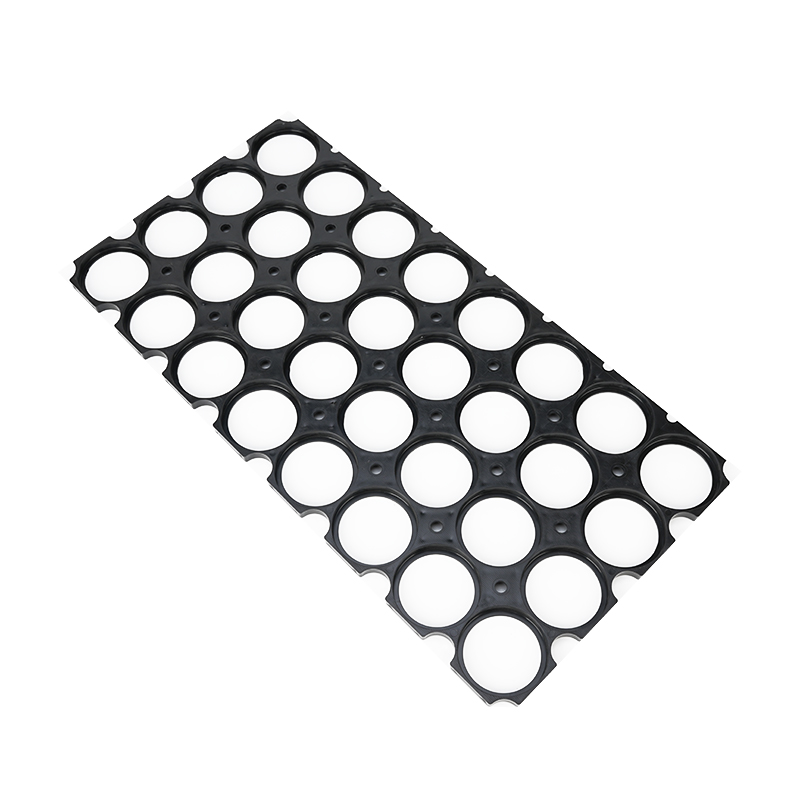
The 65120 Battery Cell Holder 4x8 Interlocking Bracket is a modular mechanical component developed for organizing large-format cylindrical battery cells into a controlled and repeatable battery-pack structure. Designed around a 4x8 physical arrangement, the holder provides 32 individual cell positions when the complete configuration is populated.
Its offset-staggered arrangement is particularly useful when battery designers need to balance compact packaging with mechanical separation and airflow. Instead of placing every cylindrical cell in a simple straight-line grid, a staggered arrangement can shift neighboring rows relative to one another. This geometry can help make efficient use of available space while preserving practical channels between cylindrical cells.
The holder is intended primarily as a mechanical positioning and support component. It does not define the electrical series or parallel configuration of the battery. Instead, it establishes the physical framework around which electrical interconnection, insulation, battery management, thermal management, enclosure protection, and monitoring systems can be developed.
A 65120 battery holder can be particularly useful in applications where large cylindrical cells must remain consistently positioned despite movement, vibration, transportation, installation, and normal equipment operation. The modular interlocking concept also makes it suitable for both prototype development and larger battery-pack assembly.
The design can be considered for applications such as:
Electric bicycles
Electric scooters
Energy storage systems
Robotics
Portable power equipment
Industrial battery systems
Custom lithium-ion battery packs
Electric mobility equipment
Battery prototypes
Modular power systems
The exact suitability of a particular holder depends on the actual dimensions of the 65120 cell, holder cavity dimensions, material specification, operating environment, and complete battery-pack design.
Understanding the 65120 Battery Cell Format
The term 65120 is commonly used to identify a cylindrical battery-cell dimensional format. In product development, however, the nominal format designation should not replace actual dimensional verification.
A battery holder must match the physical characteristics of the intended cell, including:
Cell diameter
Cell length
Terminal arrangement
Terminal protrusion
Manufacturing tolerance
Surface protection
Insulating sleeve dimensions
Different battery manufacturers can produce cells with dimensional variations even when they are marketed under a similar nominal format.
For this reason, the holder cavity should always be evaluated against the actual cell being used.
The primary purpose of the holder is to establish a controlled mechanical relationship between neighboring cells.
What Does 4x8 Mean?
A 4x8 holder refers to a physical matrix containing four rows and eight cell positions, or the equivalent orientation depending on the product's installation direction.
A fully populated arrangement provides:
4 × 8 = 32 physical cell positions.
This number describes mechanical capacity.
It does not mean:
4S8P
8S4P
32S
32P
The electrical architecture must be determined independently.
This distinction is important when creating technical product descriptions because mechanical cell arrangement and electrical cell configuration are separate engineering concepts.
Offset-Staggered Cell Arrangement
One of the important characteristics of this holder is its offset-staggered design.
In a conventional rectangular arrangement, neighboring cells are positioned directly beside one another in straight rows and columns. In a staggered configuration, adjacent rows are offset.
This creates a different geometric relationship between neighboring cylindrical cells.
For large cylindrical battery cells, staggered positioning can be useful when designers are attempting to optimize the relationship between:
Packaging density
Cell clearance
Air movement
Mechanical stability
Module dimensions
Cooling paths
Enclosure utilization
The exact benefits depend on the actual holder geometry and the complete battery structure.
Why Use a Staggered Battery Holder?
Cylindrical cells naturally create curved surfaces and spaces between adjacent cells.
A staggered arrangement uses this geometry differently from a conventional rectangular grid.
Potential benefits include:
More efficient use of enclosure space
Controlled cell-to-cell clearance
Improved layout flexibility
More natural airflow pathways
Better mechanical organization
Flexible module geometry
The staggered design should not be interpreted as automatically providing superior thermal performance in every battery application. Thermal behavior must be verified through the complete battery module.
Space-Saving Battery Pack Architecture
Battery designers frequently face restrictions on available enclosure volume.
A battery module may need to fit inside:
Bicycle frames
Scooter decks
Compact equipment housings
Robotic platforms
Industrial cabinets
Portable power enclosures
Every millimeter of internal space can become important.
A staggered holder provides another mechanical layout option for optimizing the available volume.
Rather than forcing every cell into a conventional square grid, the offset arrangement can allow designers to explore alternative packing geometries.
Airflow and Thermal Management
Battery cells generate heat during charging and discharging.
Thermal management is therefore a major consideration in cylindrical-cell battery design.
A holder can influence thermal behavior by controlling:
Cell spacing
Air passage
Contact points
Cell orientation
Module geometry
The offset-staggered structure may preserve useful spaces around cylindrical cells, which can be incorporated into a broader cooling strategy.
However, a holder alone cannot guarantee sufficient thermal performance.
A complete thermal analysis should consider:
Cell chemistry
Current load
Cell internal resistance
Ambient temperature
Enclosure design
Cooling method
Airflow rate
Heat-transfer materials
Operating cycle
Natural Convection
For certain battery systems, natural convection can contribute to heat removal.
A staggered cell arrangement may create open spaces between neighboring cylindrical surfaces.
These spaces can potentially assist natural air movement when the module is correctly oriented.
Natural convection depends strongly on:
Temperature difference
Module orientation
Air volume
Enclosure openings
Cell spacing
Surrounding components
Therefore, the holder should be considered part of the thermal design rather than treated as an independent cooling solution.
Forced Air Cooling
Some battery applications require forced-air cooling.
This may be relevant to higher-power battery packs or systems operating under demanding continuous loads.
A modular holder can help establish a predictable cell arrangement around which cooling channels can be planned.
Designers may consider:
Air inlet location
Air outlet location
Fan placement
Flow direction
Cell orientation
Air channel dimensions
Pressure drop
Computational fluid dynamics or physical thermal testing can be used when precise cooling performance is important.
Secure Cell Positioning
A major purpose of a Cylindrical Battery Holder is to keep individual cells in their intended positions.
Cell movement can occur as a result of:
Vibration
Mechanical shock
Transportation
Installation
Equipment movement
Repeated operation
A properly dimensioned holder provides a physical reference around each cell.
This can reduce uncontrolled lateral movement and help maintain consistent module geometry.
Uniform Cell Spacing
Uniform spacing is important in battery module construction.
Consistent spacing can support:
Electrical insulation
Mechanical clearance
Thermal planning
Busbar routing
Sensor installation
Assembly repeatability
When cells shift from their intended positions, spacing may become inconsistent.
A structured holder helps maintain the original design geometry.
Mechanical Cell Retention
The cell cavity should provide appropriate mechanical support without creating excessive stress.
A well-designed holder should balance:
Retention + Accessibility + Clearance + Dimensional Stability
If the cavity is too loose, cells may move.
If the cavity is excessively tight, insertion can become difficult and unnecessary mechanical pressure may be applied to the cell.
The correct fit depends on:
Cell dimensions
Holder material
Manufacturing tolerances
Temperature variation
Assembly method
Application environment
Robust and Stable Structure
Large cylindrical cells can have considerable mass compared with smaller battery formats.
When dozens of cells are assembled together, the total module weight becomes significant.
The holder therefore needs to maintain its geometry under expected mechanical loads.
A robust battery holder can contribute to:
Module rigidity
Cell alignment
Structural organization
Vibration resistance
Handling stability
Assembly consistency
Actual structural performance depends on material selection and geometry.
Vibration-Resistant Battery Pack Design
Electric mobility products are exposed to vibration.
Examples include:
E-bikes
Electric scooters
Utility vehicles
Robotics
Portable machinery
A battery holder can reduce relative movement between cells by keeping them in defined positions.
This can help the battery module maintain its intended physical structure during operation.
However, vibration resistance is a system-level characteristic.
The holder must work together with:
Cell retention
Module enclosure
Mounting brackets
Electrical connections
Insulation
Shock-absorbing materials
Mechanical Shock
Battery modules may experience sudden mechanical forces during transportation or operation.
Potential sources include:
Dropping
Road vibration
Rough terrain
Equipment impact
Improper handling
Vehicle movement
The holder can provide an internal mechanical framework, but it should not be expected to absorb all impact energy.
A complete battery enclosure should be designed to protect the cells against the expected mechanical environment.
Modular Interlocking Structure
The interlocking structure is another major advantage of this battery holder concept.
Instead of requiring one large custom plastic grid for every battery size, modular sections can be designed to connect together.
This allows battery builders to develop larger or differently shaped assemblies from compatible holder components.
Potential configurations can include:
Single modules
Extended rows
Multiple connected blocks
Rectangular battery arrays
Custom enclosure layouts
The exact possible combinations depend on the connector geometry.
DIY Battery Pack Assembly
A modular holder can be useful for DIY battery-pack projects because it provides a physical framework for organizing cylindrical cells.
A typical development process may include:
Confirm the cell dimensions.
Select a compatible holder.
Determine the required cell count.
Plan the physical module.
Select the electrical configuration.
Plan insulation.
Plan the BMS.
Plan thermal management.
Assemble the mechanical structure.
Inspect the completed battery module.
DIY builders should understand that mechanical organization is only one part of battery construction.
Lithium-ion battery assembly involves electrical and thermal hazards and should be performed using appropriate engineering controls.
Large-Scale Battery Pack Assembly
The same modular concept can be useful in more structured manufacturing environments.
For production assembly, standardized holder modules can help create repeatable processes.
Potential benefits include:
Consistent cell placement
Reduced manual measuring
Repeatable module geometry
Easier assembly instructions
Simplified inspection
Faster mechanical preparation
Production environments should establish appropriate quality-control procedures for the complete battery system.
Reusable Battery Holder Concept
A durable holder can potentially be removed and reused when the application permits.
This may be useful during:
Prototyping
Engineering evaluation
Battery layout testing
Module redesign
Maintenance
Training
Demonstration projects
Reuse depends on the condition of the holder.
A holder showing cracks, deformation, damaged connectors, or loss of structural integrity should not be reused without appropriate evaluation.
Eco-Friendly Material Considerations
The phrase eco-friendly battery holder should be used carefully.
A plastic component may have environmental advantages such as:
Long service life
Reusability
Reduced replacement frequency
Efficient material use
Potential recyclability
However, environmental performance depends on the complete material composition and end-of-life process.
The holder should therefore be considered within a broader product lifecycle.
Non-Toxic Plastic Construction
Engineering plastics selected for battery holders should be appropriate for the intended application.
A material described as non-toxic should be supported by relevant material documentation and should not be interpreted as a universal safety certification.
For industrial products, material selection may consider:
Chemical composition
Flame performance
Mechanical properties
Thermal characteristics
Electrical insulation
Environmental exposure
Regulatory requirements
Impact-Resistant Plastic
Impact resistance is valuable for battery holders used in mobile applications.
A holder may experience mechanical forces during installation and operation.
Impact-resistant plastic can reduce the likelihood of structural cracking under suitable conditions.
Important variables include:
Material grade
Wall thickness
Geometry
Temperature
Impact energy
Manufacturing quality
No plastic material is immune to damage under all conditions.
Long-Term Service Life
Long-term service life depends on much more than material selection.
Factors that influence durability include:
Operating temperature
Mechanical loading
Vibration
UV exposure
Chemical exposure
Assembly cycles
Connector engagement cycles
Cell weight
Enclosure support
A holder intended for long-term use should be evaluated under representative environmental conditions.
Dimensional Stability
Dimensional stability is particularly important for modular holders.
Changes in the holder's dimensions can affect:
Cell fit
Interlocking connection
Module alignment
Enclosure installation
Cell spacing
Engineering plastics with appropriate thermal and mechanical properties can help maintain stable geometry.
Nevertheless, temperature and load conditions should be considered during product design.
Injection-Molded Battery Holder
A 65120 battery holder with complex cavities and modular connectors can be manufactured through injection molding.
Injection molding is widely used for engineering plastic components because it can create multiple geometric features within a single part.
Possible molded features include:
Cylindrical cell cavities
Staggered positioning
Interlocking connectors
Structural ribs
Reinforcement elements
Alignment features
Mounting interfaces
Injection Molding Advantages
Injection molding can provide several manufacturing advantages.
These include:
Repeatable geometry
Consistent cavity placement
High production efficiency
Integrated structural features
Good surface consistency
Reduced secondary assembly
For high-volume production, injection molding can provide an efficient way to manufacture standardized battery holder components.
Mold Accuracy
The quality of the mold directly affects the finished holder.
Important mold-design considerations include:
Cavity dimensions
Connector tolerances
Shrinkage compensation
Draft angles
Cooling channels
Ejection structure
Warpage control
Interlocking components require particularly careful dimensional control.
Cell Cavity Design
The cavity surrounding each cell is one of the most important features of the holder.
A well-designed cavity should consider:
Cell diameter
Cell sleeve thickness
Manufacturing tolerance
Insertion method
Removal method
Thermal expansion
Mechanical retention
The cavity should support the cell without interfering with necessary electrical or thermal components.
Cell Sleeve Compatibility
Cylindrical lithium-ion cells commonly have an external insulating sleeve.
The holder cavity must account for the actual outer diameter of the finished cell, not merely the nominal diameter of the bare cell.
Additional considerations may include:
Sleeve thickness
Insulation condition
Terminal insulation
Protective rings
Cell labeling
Surface irregularities
Terminal Clearance
The battery holder should not interfere with cell terminals.
Adequate clearance can help prevent accidental mechanical contact between conductive components and the holder or neighboring structures.
Terminal areas require particular attention because they are electrically active parts of the battery.
Additional insulation may be required depending on the electrical design.
Busbar and Nickel Strip Planning
A structured holder can help create a predictable environment for electrical interconnection.
Depending on the battery architecture, designers may use:
Nickel strips
Nickel-plated steel
Busbars
Conductive plates
Flexible conductors
Fused interconnects
The holder should not be assumed to provide electrical protection by itself.
Electrical connections must be engineered independently.
Battery Management System Integration
A battery management system is often required in lithium-ion battery packs.
The BMS may monitor:
Cell voltage
Pack voltage
Current
Temperature
Charging conditions
Discharging conditions
A well-organized cell matrix can make it easier to route monitoring wires and position temperature sensors.
The holder itself does not replace the BMS.
Temperature Sensor Placement
Temperature sensors may be installed at strategic positions within a battery module.
The best locations depend on:
Cell configuration
Expected heat generation
Cooling method
Pack enclosure
Electrical load
The modular holder can provide a stable mechanical reference for sensor placement.
Thermal Expansion
Materials and battery cells can change dimensions with temperature.
A battery holder should allow for expected dimensional changes without creating excessive stress.
This is particularly important when:
The battery experiences large temperature variations
The cell diameter is closely matched to the cavity
Multiple modules are tightly connected
The enclosure provides limited expansion space
Battery Enclosure Design
The holder should be considered together with the external enclosure.
The enclosure may provide:
Environmental protection
Mechanical strength
Water and dust resistance
Mounting support
Thermal management
Crash protection
The holder organizes the cells internally, while the enclosure protects the complete module externally.
Water and Moisture Considerations
The holder itself may not provide waterproofing.
If the battery is used in an outdoor application, such as an e-bike or scooter, the overall pack may need protection from:
Rain
Splashing water
Condensation
Humidity
Dust
Water protection is primarily determined by the battery enclosure, seals, cable interfaces, and construction methods.
E-Bike Battery Applications
Electric bicycles require battery packs that can withstand repeated movement and vibration.
A 65120 battery holder can provide a structured internal cell arrangement for appropriately sized cylindrical cells.
Potential design considerations include:
Compact enclosure dimensions
Mechanical vibration
Cell retention
Thermal management
Battery weight
BMS integration
Charging safety
The holder should be matched to the actual e-bike battery architecture.
Electric Scooter Applications
Electric scooters can expose battery packs to vibration and mechanical shock.
A structured holder can help keep cells organized inside the battery enclosure.
The offset arrangement may also provide a useful packaging option where enclosure geometry is not perfectly rectangular.
For scooter applications, designers should consider:
Road vibration
Impact
Water exposure
Battery mounting
Cooling
Serviceability
Energy Storage Applications
Energy storage systems can use large numbers of cylindrical cells.
A modular holder can provide a repeatable mechanical framework for constructing larger battery modules.
Potential uses include:
Residential energy storage
Commercial backup systems
Renewable energy storage
Portable energy systems
Industrial energy storage
Large stationary systems require comprehensive thermal, electrical, mechanical, and fire-safety engineering.
Robotics Applications
Robots often have limited internal space.
A staggered battery holder can offer another way to organize cylindrical cells inside irregular equipment enclosures.
Potential benefits include:
Compact packaging
Repeatable cell positioning
Modular construction
Easier maintenance
Controlled internal organization
Robot battery systems should also consider acceleration, vibration, and impact.
Portable Power Equipment
Portable power systems frequently require high-capacity battery assemblies in relatively compact housings.
A structured holder can organize cylindrical cells while providing a stable mechanical framework.
Applications may include:
Portable power stations
Mobile tools
Backup power equipment
Outdoor electrical equipment
Industrial portable devices
Industrial Battery Systems
Industrial equipment may require battery modules capable of operating for long periods under demanding conditions.
A durable holder can help maintain cell organization within larger modules.
Industrial applications may place additional emphasis on:
Long service life
Mechanical stability
Temperature management
Maintenance access
Repeatable production
Safety validation
Custom Battery Pack Development
Custom battery packs often have unique dimensional requirements.
The available enclosure may not accommodate a standard rectangular cell arrangement.
An offset-staggered holder provides an additional packaging geometry for designers.
Customization may involve:
Module quantity
Holder dimensions
Cell spacing
Connector arrangement
Material grade
Reinforcement structure
Mounting interfaces
Prototype Battery Development
During prototyping, engineers frequently change the number and arrangement of cells.
A modular holder can make physical modifications easier.
For example, engineers may compare:
Compact layouts
Wider layouts
Longer layouts
Different cooling paths
Different enclosure shapes
A reusable mechanical component can reduce the time required to create multiple physical prototypes.
Battery Module Organization
A well-organized battery module is easier to inspect and maintain.
The holder can create predictable relationships between:
Cells
Conductors
Sensors
Insulation
Cooling components
Enclosure surfaces
This can improve the clarity of the internal battery structure.
Serviceability
Serviceability is an important consideration for modular battery systems.
A removable or interlocking holder can potentially make it easier to access individual sections of the battery module.
This may support:
Inspection
Testing
Component replacement
Prototype modification
Mechanical reconfiguration
Actual serviceability depends on the complete battery construction.
Manufacturing Quality Control
Quality control should be applied to every important characteristic of the holder.
Potential inspection items include:
Overall dimensions
Cell cavity diameter
Cell cavity depth
Center-to-center spacing
Stagger offset
Connector dimensions
Material consistency
Surface condition
Warpage
Cracks
Flash
Functional assembly testing can verify the fit between connected holder sections.
Connector Inspection
Interlocking connectors should be checked for:
Correct geometry
Proper engagement
Excessive looseness
Excessive insertion force
Cracks
Deformation
Manufacturing flash
A connector that does not engage correctly can affect the stability of the complete module.
Warpage Control
Plastic components can experience warpage during injection molding.
Warpage can affect:
Cell alignment
Holder flatness
Connector fit
Enclosure compatibility
Proper mold cooling, material selection, wall-thickness design, and process control can help reduce unwanted deformation.
Material Selection
The material should be selected based on the actual application.
Important properties may include:
Mechanical strength
Impact resistance
Heat resistance
Flame performance
Electrical insulation
Chemical resistance
Dimensional stability
No single material property determines overall battery-holder performance.
Flame Retardancy
Where required, flame-retardant engineering plastics can be considered.
A flame-retardant grade can provide improved resistance to ignition or flame propagation under specified test conditions.
However, flame retardancy does not eliminate battery fire hazards.
Lithium-ion battery safety depends on the entire system, including:
Cell quality
Charging controls
BMS
Current protection
Thermal management
Insulation
Mechanical protection
Enclosure design
Electrical Isolation
The holder can contribute to physical separation between cells and surrounding structures.
However, additional electrical insulation may be required.
Possible Insulation Materials include:
PET film
PC film
Polyimide film
Fish paper
Insulating tape
Heat-shrink tubing
Electrical barriers
The insulation system should be selected according to voltage, temperature, dielectric strength, and mechanical requirements.
Chemical Resistance
Battery systems may be exposed to various substances during manufacturing or operation.
Material selection can consider resistance to:
Oils
Cleaning agents
Moisture
Electrolyte exposure
Industrial chemicals
Actual chemical resistance must be verified against the specific material grade and chemical involved.
UV Exposure
Outdoor applications may expose battery components to sunlight.
If the holder is located inside a fully enclosed battery housing, direct UV exposure may be limited.
For externally exposed components, UV resistance may become more important.
The appropriate polymer formulation should be selected according to the exposure environment.
Temperature Cycling
Battery systems may repeatedly transition between different temperatures.
Temperature cycling can affect:
Plastic dimensions
Cell fit
Connector engagement
Material stiffness
Mechanical stress
Testing under representative temperature cycles can help identify long-term mechanical issues.
Transportation Considerations
Battery modules can experience mechanical loads during shipping.
A holder can contribute to internal cell organization during transportation.
However, the complete battery package should include suitable external protection against:
Impact
Vibration
Compression
Environmental exposure
Transportation requirements depend on the battery chemistry, configuration, energy level, and applicable regulations.
Assembly Workflow
A typical mechanical assembly workflow can be organized as follows.
Measure representative cells and compare their dimensions with the holder specifications.
Check cavities, connectors, reinforcement structures, and surfaces.
Determine how many holder sections are required.
Connect the holder components according to their designed orientation.
Place each cell into the corresponding cavity.
Check that cells remain properly positioned.
Add the appropriate electrical interconnections and protection components according to the approved design.
Install required insulating barriers and protective materials.
Install cooling or heat-management components if required.
Check the completed assembly before operation.
Storage Recommendations
Unused holders should be stored appropriately.
Recommended practices include:
Keep components dry
Avoid excessive heat
Avoid direct sunlight
Prevent heavy compression
Protect interlocking structures
Keep surfaces clean
Long-term compression can deform plastic components.
Maintenance
Regular inspection can help identify mechanical problems before they become more serious.
Inspection can include:
Cell movement
Holder cracking
Connector damage
Structural deformation
Insulation condition
Wiring condition
Signs of overheating
If structural damage is discovered, the complete battery module should be evaluated before continued operation.
Safety-Oriented Mechanical Design
Mechanical organization is an important part of battery safety.
A well-designed holder can help prevent uncontrolled cell movement and maintain predictable spacing.
Nevertheless, mechanical safety must be integrated with electrical and thermal safety.
A complete design may need:
Cell protection
BMS
Overcurrent protection
Temperature monitoring
Appropriate insulation
Thermal management
Mechanical enclosure
Proper charging equipment
Difference Between Cell Holder and Battery Protection System
A cell holder is primarily a mechanical component.
Its main functions include:
Positioning
Supporting
Organizing
Separating
Connecting modular sections
A battery protection system performs different functions, such as:
Voltage monitoring
Current protection
Temperature monitoring
Charging control
Fault detection
The two systems complement each other but cannot replace one another.
Difference Between Cell Arrangement and Battery Capacity
A 4x8 holder contains 32 physical positions.
This does not automatically determine battery capacity.
Battery capacity depends on factors such as:
Cell capacity
Number of parallel cells
Electrical configuration
Cell chemistry
Operating conditions
Likewise, physical cell arrangement does not automatically determine nominal voltage.
Voltage depends on the series configuration.
Design Advantages of the 65120 4x8 Holder
The 65120 4x8 interlocking bracket provides a combination of mechanical organization and modular packaging.
Its key advantages can be summarized as:
Offset-staggered physical arrangement
Efficient use of available space
Controlled cell positioning
Consistent mechanical spacing
Modular construction
Interlocking assembly
Potential airflow pathways
Strong mechanical organization
Reusable design concept
Broad application potential
Why Staggered Geometry Matters
The geometry of a battery module affects how efficiently cells occupy a given enclosure.
A staggered arrangement can create a different relationship between neighboring cylindrical surfaces compared with a standard rectangular grid.
This can provide additional flexibility when designing compact battery systems.
For example, the designer can evaluate the staggered arrangement against enclosure walls, cooling channels, wiring routes, and structural supports.
Packaging Efficiency
Packaging efficiency is particularly important in electric mobility.
Battery designers may need to maximize available energy without making the enclosure unnecessarily large.
The physical arrangement of cells influences:
Module footprint
Module height
Internal voids
Cooling space
Wiring routes
Structural support
The 4x8 holder offers another option for optimizing these variables.
Battery Pack Customization
Different equipment platforms require different battery dimensions.
A battery for an e-bike may require a narrow elongated configuration.
A scooter may require a low-profile module.
An energy storage system may prioritize modular expansion.
A robotic system may need an irregular enclosure.
The interlocking structure can support a more adaptable mechanical development process.
Scalability
Modularity can improve scalability from prototypes to larger assemblies.
A basic holder unit can potentially be used to develop:
Prototype packs
Small modules
Medium battery systems
Larger interconnected arrays
This can reduce the need for completely different mechanical concepts across development stages.
Mechanical Integration With Cooling Systems
Cooling systems may include:
Air cooling
Heat sinks
Thermal pads
Cooling plates
Liquid cooling structures
The holder should be evaluated together with the chosen cooling architecture.
A staggered arrangement may influence the available space for cooling components.
Mechanical Integration With Insulation
The holder provides mechanical organization, while insulation provides electrical separation.
These functions can complement one another.
Designers should ensure that insulation materials do not interfere with:
Cell insertion
Connector engagement
Cooling
Electrical connections
Maintenance
Product Selection Considerations
When selecting a 65120 battery cell holder, buyers and engineers should verify:
Actual cell diameter
Actual cell length
Number of cell positions
4x8 layout dimensions
Stagger offset
Cavity tolerance
Material grade
Flame-retardant specification
Connector design
Overall holder dimensions
Operating temperature
Intended application
A product description alone should not replace technical dimensional verification.
Customization Possibilities
Depending on production requirements, battery holder designs may be customized.
Possible customization areas include:
Cell cavity size
Cell spacing
Holder length
Holder width
Holder height
Connector geometry
Reinforcement structure
Mounting holes
Material formulation
Surface finish
Color
Custom tooling may be required for substantial structural modifications.
Black Battery Cell Holder
Black is a commonly selected color for battery holder components.
A black holder can provide a clean industrial appearance and make the component easy to distinguish during assembly.
Color can also be customized when material formulation and production requirements allow.
The color itself does not determine the mechanical or thermal performance of the material.
Industry Applications
The 65120 Battery Cell Holder 4x8 Interlocking Bracket can be considered for a wide range of cylindrical battery applications.
Potential industries include:
Electric mobility
Renewable energy
Energy storage
Robotics
Consumer electronics
Industrial equipment
Portable power
Electric transportation
Battery prototyping
Custom power systems
The final application should always be evaluated according to the actual cell, electrical architecture, thermal conditions, and safety requirements.
Frequently Asked Questions
It is a modular mechanical holder designed to organize compatible 65120 cylindrical battery cells in a 4x8 physical arrangement.
A complete 4x8 arrangement provides 32 physical cell positions.
No. The 4x8 designation describes the physical cell layout and does not specify the electrical series-parallel configuration.
It is a cell arrangement in which neighboring rows are shifted relative to one another instead of being aligned in a conventional rectangular grid.
It can provide an alternative method of using enclosure space while maintaining controlled cell separation and potentially useful airflow pathways.
No. Thermal performance depends on the complete battery design, including cell characteristics, enclosure, airflow, cooling system, ambient conditions, and operating load.
A properly matched holder can help maintain cell positioning and reduce uncontrolled mechanical movement.
It can contribute to mechanical organization in vibration-exposed applications, but the complete battery assembly must be evaluated for vibration resistance.
Yes, where the 65120 cell dimensions, holder design, enclosure, thermal requirements, and electrical architecture are compatible.
It can be considered for suitable scooter battery designs, particularly where compact cylindrical-cell organization is required.
Yes. Modular cylindrical-cell holders can be incorporated into appropriately engineered energy storage modules.
The holder may be reusable when it remains structurally intact and is compatible with the next assembly.
A durable and reusable plastic component can contribute to longer product service life, but overall environmental performance depends on material composition, manufacturing, reuse, and end-of-life recycling.
Yes. Impact resistance can help the holder withstand mechanical forces during handling and normal application conditions.
Depending on tooling and production requirements, dimensions, cell spacing, connector structures, material grade, and other features may be customized.
No. Black is a common industrial color, but other colors may be possible depending on the material and manufacturing requirements.
The plastic structure can provide mechanical separation and may have electrical insulating properties, but additional insulation should be used where required by the battery design.
The holder can influence cell spacing and airflow, but it is not a complete thermal protection system.
No. A battery holder is a mechanical component and does not replace a battery management system.
Technical Design Summary
The 65120 Battery Cell Holder 4x8 Interlocking Bracket is best understood as a modular mechanical platform for cylindrical-cell battery construction.
Its 4x8 arrangement provides 32 physical positions, while the offset-staggered geometry creates an alternative approach to cell packaging. This arrangement can be useful where designers need to balance compactness, spacing, mechanical organization, and thermal planning.
The interlocking architecture can simplify module expansion and enable compatible holder sections to be combined into larger battery structures. This makes the concept suitable for prototype development as well as structured production environments.
Secure cell positioning helps reduce uncontrolled movement and maintain predictable spacing. This is particularly relevant to mobile equipment exposed to vibration, such as e-bikes, scooters, robotics, and other electric mobility products.
The reusable concept can also support engineering development, allowing compatible holder components to be removed, rearranged, inspected, and potentially reused when their structural condition remains satisfactory.
Conclusion
The 65120 Battery Cell Holder 4x8 Interlocking Bracket is a flexible mechanical solution for organizing large cylindrical battery cells into a structured and modular battery-pack architecture.
Its offset-staggered design offers an alternative to conventional straight-grid cell arrangements. By shifting neighboring rows, the structure can make efficient use of available packaging space while maintaining controlled cell separation. Depending on the complete module design, the resulting geometry can also provide useful opportunities for airflow and thermal-management planning.
The holder's secure cell positioning helps establish consistent mechanical relationships between individual cells. Maintaining predictable spacing can simplify module assembly and support the planning of insulation, electrical connections, temperature sensors, and cooling pathways.
Its robust and stable mechanical structure is especially relevant to battery packs exposed to vibration and movement. Applications such as electric bicycles, electric scooters, robotics, portable equipment, and other mobile power systems can benefit from controlled internal cell organization.
The modular interlocking structure provides additional flexibility. Compatible sections can potentially be connected to create larger or differently shaped battery modules. This makes the holder useful for DIY battery projects, engineering prototypes, customized battery systems, and larger-scale battery-pack assembly.
The reusable and durable design concept can also contribute to longer mechanical service life. When manufactured from appropriate impact-resistant engineering plastic, the holder can maintain useful structural performance under suitable operating conditions. Environmental benefits should be evaluated across the complete material lifecycle rather than based solely on the use of plastic.
The 4x8 designation provides 32 physical cell positions, but it does not determine the electrical configuration, battery capacity, or voltage. These characteristics must be established independently through the electrical design.
For reliable battery development, the holder should be evaluated together with the cells, BMS, electrical interconnections, insulation, thermal management system, enclosure, mounting structure, and intended operating environment.
Overall, the 65120 4x8 Interlocking Battery Cell Holder provides a practical foundation for structured cylindrical-cell battery assembly. Its combination of offset-staggered packaging, secure cell positioning, modular interlocking construction, repeatable geometry, and reusable mechanical design makes it suitable for a broad range of custom battery-pack applications, including e-bikes, electric scooters, energy storage systems, robotics, portable power equipment, industrial battery systems, and other electric mobility solutions.
This website uses cookies to ensure you get the best experience on our website.



 Phone
Phone