

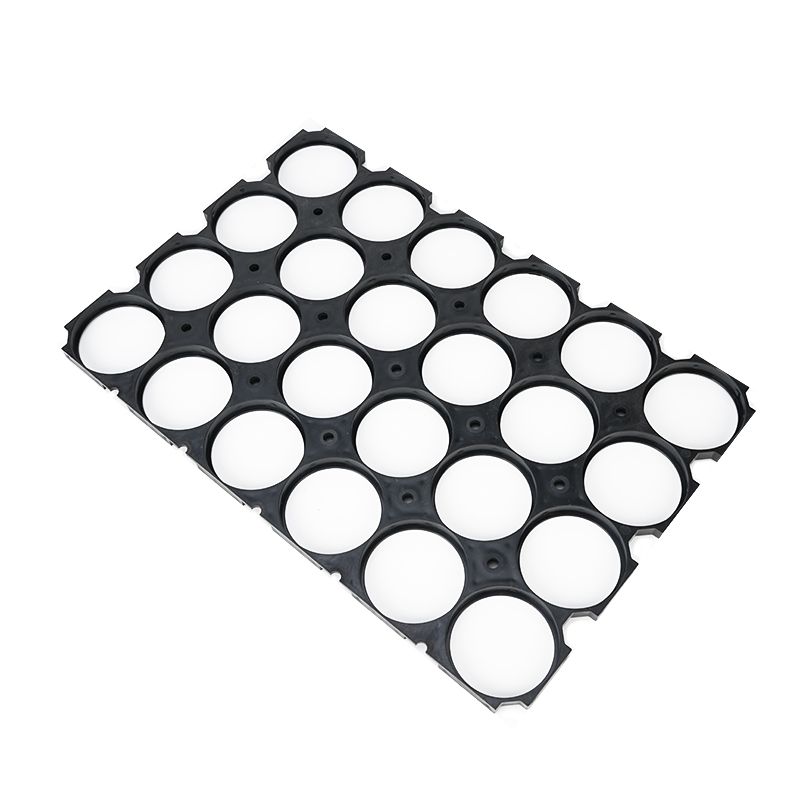
The 65120 Battery Cell Holder 4x6 Interlocking Bracket is a modular structural component developed for cylindrical lithium-ion battery pack assembly. Designed around the requirements of large-format cylindrical cells, this type of battery holder provides organized cell positioning, mechanical separation, electrical insulation, and improved assembly stability.
A well-designed battery cell holder is more than a simple plastic frame. During battery pack manufacturing, cylindrical cells must remain correctly aligned while Nickel Strips, busbars, Insulation Materials, wiring, and protective components are installed. The holder creates a defined mechanical structure around the cells, helping maintain consistent spacing and reducing unwanted movement during assembly and operation.
The 4x6 configuration is particularly suitable for modular battery pack construction because multiple holder sections can be combined to create larger arrays. Interlocking structures allow individual sections to connect mechanically, making it possible to expand the battery layout according to the required pack dimensions.
For applications where thermal management, vibration resistance, electrical isolation, and assembly efficiency are important, a flame-retardant battery holder made from an ABS + PC material system can provide a useful combination of structural rigidity, impact resistance, insulation performance, and heat resistance.
This product category can be used in DIY battery projects as well as professional battery module development, provided that the selected holder dimensions correspond correctly to the actual cell diameter and mechanical requirements.
A 65120 battery cell holder is a molded plastic support structure designed to organize cylindrical cells identified by the 65120 format. The numerical designation generally refers to a cylindrical cell size, but actual cell dimensions, terminal configuration, insulation requirements, and manufacturer-specific tolerances should always be verified before selecting a holder.
The holder normally contains multiple cylindrical cavities or positioning features. Each cavity receives one battery cell and helps keep it in a predetermined location.
The 4x6 interlocking bracket designation describes a holder arrangement consisting of 24 cell positions when all 24 cavities are populated. Depending on the battery-pack architecture, the holder may be used as an upper support, lower support, or as part of a paired holder system.
The interlocking function allows multiple holder modules to connect together. Instead of constructing an entire battery pack from one large molded frame, modular sections can be combined to create different cell counts and physical dimensions.
This approach is useful for battery manufacturers and battery-pack designers who need flexibility during product development.
Flame retardancy is an important consideration for battery-pack structural components. Cylindrical lithium-ion cells can operate under demanding electrical and thermal conditions, so nonconductive structural parts should be selected with appropriate material and safety characteristics.
An ABS + PC flame-retardant material system combines characteristics from acrylonitrile butadiene styrene and polycarbonate.
ABS is widely used in molded battery accessories because it provides good dimensional stability, processability, surface quality, and impact resistance. Polycarbonate can contribute higher impact strength, temperature resistance, and mechanical robustness.
When an appropriately formulated flame-retardant ABS-PC grade is selected, the material may be available with a UL94 V-0 rating or another applicable flame classification. However, the actual flame rating depends on the exact resin formulation, thickness, processing conditions, and certification of the material. Therefore, the rating should be confirmed against the material documentation for the specific product.
A flame-retardant holder does not make the battery pack itself fireproof. Instead, it can contribute to the overall material safety strategy of the assembly.
The main purpose of a battery cell holder is to create a controlled mechanical environment around the cells.
Cylindrical battery cells can move when a pack is subjected to vibration, shock, transportation, or repeated mechanical loading. Properly designed holder cavities help keep each cell in its designated location.
Stable positioning is particularly important during nickel-strip spot welding because excessive cell movement can complicate welding alignment.
Consistent spacing between cylindrical cells creates a predictable mechanical arrangement. It also provides space for insulation and can assist the design of airflow paths around the cells.
Uniform spacing is especially useful in larger battery modules where dozens of cylindrical cells must remain aligned.
Most battery holders are manufactured from electrically insulating plastic. The holder can provide physical separation between adjacent cells and reduce the possibility of unwanted direct contact between conductive cell surfaces.
The holder should nevertheless be considered one part of the insulation system. Additional insulation such as fish paper, PET film, polyimide tape, insulating sleeves, or other appropriate materials may be required depending on the pack design.
A modular holder can add rigidity to the overall battery assembly. When correctly designed and assembled, the holder reduces free movement of individual cells and helps maintain the geometry of the module.
The holder establishes a repeatable cell layout. Instead of manually positioning every cell, the assembler can place the cells into predetermined cavities.
This can improve assembly consistency and reduce positioning errors.
ABS + PC Material for Stable Structure
ABS-PC is widely considered a useful engineering thermoplastic combination for applications requiring a balance between toughness, processability, and temperature performance.
For a battery cell holder, material selection should consider several factors.
| Material characteristic | Importance in battery holders |
|---|---|
| Mechanical strength | Helps support cells and maintain the module structure |
| Impact resistance | Helps withstand handling and vibration |
| Electrical insulation | Helps separate conductive battery components |
| Dimensional stability | Helps maintain consistent cell positioning |
| Heat resistance | Supports use around moderately elevated operating temperatures |
| Flame retardancy | Can improve material fire-performance characteristics |
| Injection molding capability | Enables repeatable production of complex holder geometries |
| Surface durability | Helps withstand repeated handling and assembly |
The exact performance of ABS-PC depends on the selected grade. Not all ABS-PC materials have the same temperature resistance or flame-retardant properties.
For professional applications, designers should evaluate the resin's technical datasheet, UL classification, continuous-use temperature, impact strength, tensile properties, dielectric characteristics, and molding requirements.
Auxiliary Heat-Dissipation Air Ducts
Thermal management is an important design consideration for cylindrical lithium-ion battery packs.
The 65120 battery holder may incorporate slotted, hollow-out, or open structural features that create additional air passages between cell positions.
These openings can serve several purposes:
Increase exposed surface area around the cells
Improve air circulation
Reduce unnecessary plastic coverage
Provide pathways for natural convection
Support forced-air cooling designs
Reduce overall holder weight
Create additional visual access for inspection
The holder itself is not a cooling system. Instead, the geometry can support a broader thermal-management design.
For high-power battery packs, thermal performance should be evaluated using actual cell characteristics, current levels, ambient conditions, enclosure geometry, airflow, and thermal-interface materials.
Cell Spacing and Thermal Management
Battery cells generate heat during charging and discharging. The amount of heat depends on cell chemistry, internal resistance, current, state of charge, ambient temperature, and operating conditions.
Consistent spacing helps create a predictable physical environment around the cells.
A holder with suitable openings can provide additional airflow channels. In naturally cooled packs, warm air can move through open regions by convection. In forced-air systems, fans can direct air through designed channels.
For sealed battery enclosures, however, airflow through the holder does not automatically guarantee sufficient cooling. The complete enclosure and thermal architecture must be evaluated.
A battery holder should therefore be considered a mechanical and thermal-management supporting component, rather than a standalone cooling solution.
Interlocking Modular Structure
One of the most useful features of a modular battery cell holder is its ability to connect with additional sections.
An interlocking bracket generally uses complementary mechanical features such as male and female connectors, tabs, slots, clips, or other molded engagement structures.
These features allow multiple holder sections to be joined together.
The modular concept can support:
Larger battery arrays
Different series and parallel configurations
Custom pack lengths
Custom pack widths
Replacement of individual holder sections
Easier transportation before final assembly
More flexible production planning
A modular design can also simplify prototyping. Battery-pack designers can test different physical layouts without requiring a completely new large frame for every configuration.
4x6 Configuration for Battery Pack Assembly
A 4x6 holder layout provides 24 cell positions when every position is populated.
The configuration can be useful for developing compact battery modules where a rectangular cell arrangement is preferred.
The exact electrical configuration remains independent of the mechanical holder. A 4x6 mechanical layout can potentially be combined with different electrical series-parallel architectures depending on cell voltage, capacity, current requirements, BMS design, and system voltage.
For example, a mechanical arrangement of 24 cells does not by itself determine whether the pack is configured as 4S6P, 6S4P, or another electrical arrangement.
The battery holder provides mechanical organization, while the electrical architecture is established through cell interconnection and battery-management design.
Preventing Cell Movement During Spot Welding
Nickel-strip spot welding requires accurate positioning between cells and conductive strips.
If cylindrical cells move during the welding process, several problems can occur:
Misaligned nickel strips
Inconsistent welding locations
Difficulty maintaining assembly tolerances
Increased operator workload
Potential mechanical damage to components
Reduced production consistency
A properly fitted holder can reduce cell movement before and during welding.
The holder keeps cells within defined positions while the operator or automated equipment places nickel strips over the intended connection points.
However, the battery holder does not replace correct welding procedures. Welding parameters, electrode pressure, pulse duration, strip material, strip thickness, cell construction, and equipment calibration must be controlled separately.
Upper and Lower Holder Configuration
Many cylindrical battery packs use a pair of structural holders.
One holder is positioned near one end of the cells while another holder supports the opposite end.
This creates a top-and-bottom clamping structure around the cylindrical cells.
The paired arrangement can provide several benefits:
Both ends of each cell are mechanically referenced by the holder system.
The distance between the upper and lower holders creates a rigid framework that helps reduce cell movement.
A two-sided support structure can help distribute mechanical forces through the module.
Cells can be inserted into predefined positions before electrical connections are completed.
The upper and lower holders create a repeatable cell matrix for larger battery assemblies.
The actual clamping force should be controlled carefully. Excessive mechanical compression may be inappropriate for some cell formats, so holder dimensions should be matched to the specific cell manufacturer's mechanical requirements.
Electrical Insulation Between Cells
Electrical insulation is one of the most important functions of a battery holder.
Adjacent cylindrical cells may have conductive metal surfaces, terminals, or nickel connections. If conductive components come into unintended contact, electrical faults can occur.
A plastic battery holder creates a physical barrier between cells.
However, the holder should not be treated as the sole insulation layer.
A complete battery pack may also use:
Cell sleeves
Fish paper rings
Insulation sheets
PET film
Polyimide tape
Busbar insulation
Terminal barriers
Adhesive Insulating Films
Protective covers
The appropriate combination depends on the battery design.
Insulation should be designed around creepage, clearance, voltage, mechanical movement, environmental conditions, and the characteristics of the cell and interconnection system.
Safety-Oriented Mechanical Design
Battery holders can support safety through mechanical organization.
A good holder design helps prevent cells from freely contacting each other and reduces uncontrolled movement.
Important mechanical characteristics can include:
Stable cell cavities
Rounded contact surfaces
Adequate wall thickness
Reinforced structural sections
Secure interlocking features
Controlled spacing
Nonconductive construction
Appropriate thermal openings
The design should avoid sharp edges that could damage cell sleeves or insulation materials.
If a holder contacts a cell sleeve, the contact surface should be sufficiently smooth to minimize abrasion during assembly and vibration.
Benefits of the 65120 Battery Cell Holder 4x6 Interlocking Bracket
The following benefits are commonly associated with a well-designed modular holder system.
The 4x6 arrangement provides a clear cell matrix.
The holder reduces uncontrolled cell movement.
Interlocking sections can be combined to create larger assemblies.
The nonconductive plastic structure helps isolate neighboring cells.
Predetermined cavities simplify cell insertion and positioning.
The holder keeps cells aligned during nickel-strip installation.
Open structural sections can provide pathways for air circulation.
Injection-molded engineering plastics provide structural support without the mass of metal frames.
Modular sections can be incorporated into different pack dimensions.
A suitable ABS-PC engineering material can provide good toughness and dimensional stability when properly selected.
Applications
Electric bicycles commonly require compact battery modules with good mechanical stability.
A 65120 cell holder can organize cylindrical cells inside a battery enclosure and help maintain the spacing required for the selected thermal and insulation design.
The holder can also assist during pack manufacturing by keeping cells aligned while electrical interconnections are installed.
Electric scooters experience vibration and mechanical shock during normal operation.
A rigid cell holder can help reduce cell movement inside the battery enclosure.
The holder is particularly useful when combined with appropriate enclosure structures, cushioning materials, insulation layers, and vibration-control components.
Modular holders are popular in DIY battery construction because they simplify physical cell organization.
Instead of manually arranging every cylindrical cell, users can install cells into predefined cavities.
DIY users should still follow appropriate battery-safety procedures, including correct cell matching, insulation, welding practices, BMS selection, fusing, enclosure design, and charging protection.
Battery-powered drills, saws, grinders, and other portable tools require compact and mechanically stable battery assemblies.
A cell holder can provide structural organization inside the pack while helping maintain consistent spacing.
The actual suitability of a 65120 holder for a particular power-tool application depends on the tool's voltage, current demand, thermal requirements, enclosure dimensions, and cell specifications.
Energy storage systems may contain large numbers of cylindrical cells.
Modular holder structures can simplify the creation of larger cell arrays by allowing smaller sections to be combined.
For stationary energy-storage applications, additional attention should be given to:
Thermal propagation management
Fire safety
Enclosure construction
Ventilation
Cell monitoring
BMS architecture
Electrical protection
Mechanical retention
The holder should form part of a complete safety architecture rather than being considered an independent safety device.
OEM and ODM Customization
OEM and ODM services can be applied to battery cell holder development where standard dimensions do not meet a particular battery-pack requirement.
Potential customization areas include:
| Customization item | Typical requirement |
|---|---|
| Cell cavity | Matched to the actual cell diameter |
| Holder length | Adjusted to pack dimensions |
| Holder width | Adjusted to pack dimensions |
| Cell quantity | Customized for the intended module |
| Connector geometry | Modified for specific modular layouts |
| Wall thickness | Optimized for strength and molding |
| Air openings | Modified for thermal-management requirements |
| Material | ABS, PC, ABS-PC, PP, PA or other engineering plastics |
| Flame rating | Selected according to application requirements |
| Surface finish | Adjusted according to manufacturing needs |
| Color | Customized when required |
| Packaging | Adapted for transportation and production |
Customized tooling may be required for nonstandard holder geometries.
Before manufacturing a custom bracket, designers should confirm the exact cell dimensions, cell tolerance, terminal arrangement, pack configuration, enclosure dimensions, assembly method, and environmental conditions.
Injection-Molded Manufacturing
Battery holders are commonly produced using injection molding.
Injection molding is suitable for producing large quantities of consistent plastic components with complex geometries.
A typical manufacturing sequence includes:
Engineering design
3D modeling
Mold-flow evaluation
Tool design
Mold manufacturing
Plastic material preparation
Injection molding
Cooling and ejection
Dimensional inspection
Assembly testing
Packaging
Injection molding allows manufacturers to integrate features such as:
Cell cavities
Reinforcement ribs
Air slots
Interlocking connectors
Alignment structures
Mounting points
Identification marks
The final geometry should be designed according to the selected resin's molding characteristics.
Dimensional Accuracy
Battery holder dimensions should be carefully controlled because small dimensional errors can affect cell fit.
Important dimensions include:
Cell cavity diameter
Cell cavity depth
Center-to-center spacing
Holder thickness
Overall length
Overall width
Connector tolerance
Upper-to-lower holder distance
If a cavity is too small, cell insertion can become difficult.
If the cavity is too large, the cell may move excessively.
Therefore, the ideal holder fit should account for the actual cell diameter tolerance and the requirements of assembly.
Compatibility Considerations
A 65120 battery holder should not be selected solely because the product name contains "65120."
Different cylindrical cells may have variations in:
Diameter
Length
Positive-terminal configuration
Negative-terminal geometry
Protective sleeve thickness
Manufacturing tolerance
Terminal protrusion
Mechanical dimensions
Before ordering or using a holder, the cell manufacturer's dimensional drawing should be compared with the holder's actual cavity dimensions.
This is particularly important for custom or high-current cylindrical cells.
Material Alternatives
Although ABS-PC is an important material choice, other plastics may also be used for battery cell holders.
ABS is widely used because it offers good impact resistance, molding characteristics, surface quality, and cost efficiency.
PC offers high impact resistance and good heat resistance. It can be useful when greater mechanical robustness is required.
PP has good chemical resistance and low density. It can be suitable for applications where flexibility and chemical resistance are important.
PA, commonly known as nylon, can provide strong mechanical performance and relatively high temperature resistance. Different grades have different moisture absorption and thermal characteristics.
Special flame-retardant grades can be selected when higher fire-performance requirements apply.
Material selection should always be based on the complete operating environment.
Flame Retardancy and UL94
The term flame-retardant battery holder should be used carefully.
A plastic holder described as UL94 V-0 must have the appropriate tested material and thickness classification.
UL94 classifications relate to the flammability behavior of plastic materials under specified laboratory test conditions. They should not be interpreted as a guarantee that an entire battery pack will not ignite or propagate fire.
For professional battery applications, the holder material certification should be reviewed together with the requirements of the final battery assembly.
Structural Reinforcement
Battery holders may incorporate ribs, columns, bridges, and reinforced corners to improve rigidity without excessively increasing material usage.
Structural reinforcement can help resist:
Compression
Bending
Vibration
Handling forces
Assembly stress
Transportation loads
A well-balanced structure can achieve sufficient rigidity while maintaining reasonable weight and material consumption.
Vibration Resistance
Battery packs used in e-bikes, scooters, power tools, drones, and vehicles can experience repeated vibration.
Uncontrolled cell movement can gradually damage insulation, electrical connections, or structural components.
A rigid holder reduces relative movement between cells.
However, vibration resistance depends on the complete pack. Factors such as enclosure stiffness, foam cushioning, mounting brackets, welding quality, cell weight, and road or equipment vibration must also be considered.
Compact Battery Pack Construction
A modular 4x6 holder can help create a compact cell matrix without requiring a large metal framework.
The cells remain organized within the molded structure while the open areas of the holder can accommodate airflow, wiring, insulation, and interconnection components.
Compact construction is especially valuable when battery designers have limited enclosure space.
The final cell pitch should balance:
Overall pack dimensions
Thermal clearance
Insulation requirements
Mechanical strength
Electrical connection space
Serviceability
Reusable and Long-Life Plastic Structure
Engineering plastic holders can potentially be reused in prototype development and selected assembly processes.
A durable holder may survive repeated installation and removal if the interlocking connectors are designed for that purpose.
However, reuse should be evaluated according to the actual design.
Repeated disassembly can eventually cause wear at clips, tabs, or interlocking points. A holder showing cracks, deformation, damaged connectors, or sharp edges should not be reused in a battery pack.
Quality Inspection
Quality control for a 65120 battery cell holder can include several inspection categories.
Measure critical dimensions such as cavity diameter, spacing, overall dimensions, and connector geometry.
Check for:
Flash
Cracks
Short shots
Warping
Sink marks
Surface damage
Deformation
Verify that interlocking sections connect correctly.
Insert representative cells and check fit, positioning, and movement.
Confirm the specified resin grade and applicable flame-retardant documentation.
For demanding applications, evaluate the holder under the intended temperature environment.
Design Considerations for Battery Manufacturers
Battery-pack designers should consider the holder early in the mechanical design process.
The holder should be evaluated together with:
Cell dimensions
Electrical configuration
BMS
Nickel strips or busbars
Insulation materials
Thermal-management system
Enclosure
Wiring
Fuse protection
Charging system
Mechanical mounting
A holder that fits the cells mechanically may still be unsuitable if it interferes with busbars, wiring, BMS components, or enclosure walls.
Installation Process
A general installation process may include:
Check for cracks, deformation, flash, or damaged interlocking features.
Confirm that the selected cells match the holder cavity specifications.
Inspect cell sleeves and insulation before installation.
Connect the interlocking brackets according to the intended layout.
Place each cylindrical cell into its designated cavity.
Where a paired structure is used, position the second holder at the opposite end.
Check that all cells remain parallel and evenly positioned.
Complete the electrical interconnection using an appropriate battery assembly process.
Confirm that conductive areas are adequately isolated.
Secure the completed module inside the appropriate enclosure.
Maintenance and Inspection
Battery holders generally require little maintenance once installed, but inspection can be useful in serviceable systems.
Look for:
Cracked plastic
Broken interlocking connectors
Cell movement
Deformed cavities
Damaged insulation
Heat discoloration
Loose mechanical components
If abnormal heating, swelling, leakage, smoke, unusual odor, or other battery fault symptoms are observed, the battery should be handled according to appropriate safety procedures rather than relying on the holder to contain the problem.
Advantages for DIY Battery Pack Builders
For DIY builders, a modular 65120 battery holder can make battery assembly more organized and repeatable.
Instead of creating a custom support frame manually, users can begin with a predefined cell matrix.
Potential benefits include:
Faster cell arrangement
Better visual organization
More consistent spacing
Easier module expansion
Improved mechanical stability
Cleaner internal structure
Easier planning of enclosure dimensions
DIY builders should still understand that the holder is only a mechanical component. Correct cell matching, electrical protection, insulation, welding, BMS configuration, charging, and enclosure design remain essential.
Advantages for Professional Battery-Pack Assembly
Professional battery manufacturers can benefit from repeatable cell positioning.
A standardized holder can help establish a consistent production workflow.
Potential production advantages include:
Repeatable cell placement
Faster assembly
Reduced manual alignment
Better dimensional consistency
Easier module handling
Simplified fixture design
Improved inspection efficiency
Modular production capability
For automated production, the holder geometry can potentially be integrated into assembly fixtures or robotic cell-placement processes.
Battery Holder and BMS Integration
The mechanical holder does not replace the battery management system.
A BMS is responsible for electrical monitoring and protection functions appropriate to the battery architecture.
Depending on the battery system, the BMS may monitor:
Cell or group voltage
Pack voltage
Temperature
Charging conditions
Discharging conditions
Overcurrent conditions
Balancing requirements
The holder simply provides the physical organization required for the battery cells.
Mechanical and electrical design should therefore be coordinated from the beginning.
Thermal Management in Large Cylindrical Battery Packs
Larger cylindrical cells can require careful thermal analysis, particularly in high-current applications.
Thermal-management strategies may include:
Natural convection
Forced-air cooling
Thermal interface materials
Conductive heat-transfer structures
Cooling plates
Liquid cooling systems
Thermally conductive pathways
The battery holder can support these systems by creating consistent spacing and open channels.
The correct solution depends on the battery's heat generation and operating environment.
Comparison of Common Holder Materials
| Material | Typical Characteristics | Potential Battery Holder Use |
|---|---|---|
| ABS | Good molding, impact resistance, economical | General battery-pack holders |
| PC | High impact resistance and heat resistance | More demanding environments |
| ABS-PC | Balanced toughness and thermal performance | Advanced structural holders |
| PP | Lightweight and chemically resistant | Flexible or lightweight designs |
| PA Nylon | Strong and relatively heat resistant | High-strength applications |
These are general material characteristics. The actual performance depends on the specific resin grade and molding design.
Typical Product Specification Framework
A battery holder product page can describe the following parameters without assuming values that must be verified separately:
| Specification | Description |
|---|---|
| Product Type | 65120 Battery Cell Holder |
| Configuration | 4x6 |
| Cell Type | Cylindrical lithium-ion battery |
| Cell Quantity | 24 positions per complete 4x6 matrix |
| Structure | Interlocking modular bracket |
| Material | ABS + PC or specified engineering plastic |
| Electrical Property | Nonconductive structural material |
| Flame Retardancy | Available in flame-retardant grades |
| Color | Commonly black |
| Manufacturing | Injection molded |
| Airflow | Slotted or open structure may support ventilation |
| Assembly | Modular mechanical connection |
| Application | E-bike, scooter, DIY pack, power tool, ESS and related systems |
Actual product specifications should always be confirmed against the manufacturer's dimensional drawing and material documentation.
Why Black Is Commonly Used
Black is one of the most common colors for battery cell holders.
It provides a clean industrial appearance and can make the holder easy to distinguish from other battery-pack components.
Black plastic can also provide a consistent visual appearance across large battery modules.
Color itself does not determine electrical or thermal performance. The important factors are the resin formulation, additives, wall thickness, processing conditions, and application environment.
Battery Holder Design for Energy Storage
Energy storage systems can involve many cylindrical cells connected into large modules.
A modular holder approach can simplify mechanical organization.
For ESS applications, the holder may help with:
Cell arrangement
Module organization
Electrical separation
Mechanical reinforcement
Airflow management
Service inspection
Assembly repeatability
Large stationary battery systems require significantly more comprehensive safety engineering than a holder alone can provide.
Thermal propagation prevention, fire detection, electrical isolation, BMS protection, enclosure ventilation, and emergency response should all be addressed independently.
Product Selection Checklist
Before selecting a 65120 battery holder, consider the following:
Cell dimensions:
Confirm the actual cell diameter and length.
Cavity fit:
Ensure the holder cavity provides appropriate retention without damaging the cell.
Cell spacing:
Confirm sufficient space for thermal management and insulation.
Material:
Select an engineering plastic suitable for the temperature and mechanical environment.
Flame performance:
If required, verify the exact flame-retardant material grade and certification.
Interlocking design:
Confirm that multiple sections can connect securely.
Upper and lower support:
Determine whether paired holders are required.
Electrical connections:
Check that the holder does not interfere with nickel strips, busbars, terminals, or wiring.
Enclosure:
Verify compatibility with the final battery enclosure.
Thermal system:
Ensure that holder openings support rather than obstruct the intended cooling strategy.
Conclusion
The 65120 Battery Cell Holder 4x6 Interlocking Bracket is a practical modular component for organizing large cylindrical lithium-ion battery cells into a stable and repeatable battery-pack structure.
Its combination of flame-retardant battery holder construction, ABS + PC engineering material, modular interlocking geometry, electrical insulation, auxiliary airflow openings, and paired upper-and-lower support capability makes this product category suitable for many cylindrical battery-pack designs.
Applications can include e-bikes, electric scooters, DIY lithium-ion battery packs, power tools, and energy storage systems.
The 4x6 configuration provides a 24-position mechanical matrix, while interlocking features make it possible to expand the layout for larger battery modules. The holder can also assist with cell alignment during nickel-strip spot welding and provide a structured foundation for insulation, thermal management, wiring, and enclosure integration.
For OEM and ODM development, dimensions, cavity tolerances, connector geometry, material grade, flame-retardant performance, airflow structure, color, and packaging can be customized according to the intended battery-pack architecture.
Ultimately, the best battery cell holder is one that matches the actual cell dimensions and integrates correctly with the complete battery system. Mechanical stability, insulation, thermal management, electrical protection, BMS design, and enclosure safety should all be evaluated together to create a reliable cylindrical battery pack.
This website uses cookies to ensure you get the best experience on our website.



 Phone
Phone