

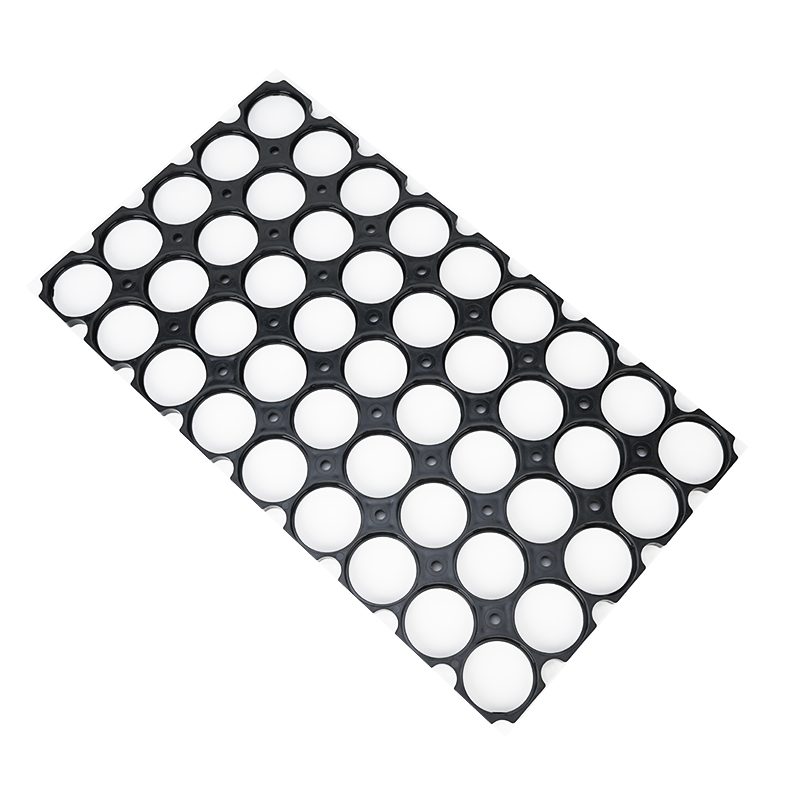
The 60160 5x9 Multi Purpose Battery Cell Holder is a precision-engineered mechanical support component developed for cylindrical lithium-ion battery pack construction. It is designed to provide controlled cell positioning, organized spacing, structural support, and flexible configuration for battery assemblies that require a stable mechanical framework.
The 5x9 designation generally describes a physical arrangement consisting of five cell positions in one direction and nine positions in another direction. A fully populated 5x9 arrangement can therefore provide 45 cell positions. The physical arrangement should not be confused with the electrical series and parallel configuration of a battery pack. The holder establishes the mechanical layout, while the electrical architecture determines voltage, capacity, current capability, and overall energy.
The 60160 battery holder concept is particularly relevant to larger-format cylindrical cells and custom battery structures. At the same time, a multi-purpose holder platform may be designed around interchangeable or modular concepts that allow different cylindrical cell formats to be considered during battery pack development.
The primary purpose of a battery cell holder is straightforward: every cell should remain in its intended location while the pack is assembled, transported, installed, and operated. Controlled positioning can make the overall battery structure more predictable and easier to manage.
For battery engineers, pack designers, integrators, research laboratories, and experienced DIY builders, a properly designed cell holder can become an important mechanical foundation for a complete battery assembly.
Understanding the 60160 Battery Cell Holder
A 60160 battery cell holder is intended for cylindrical battery cells associated with the 60160 size category. The name generally refers to a cell format with approximate dimensional characteristics associated with its diameter and length.
However, nominal cell designations should not be used as the sole basis for compatibility.
Actual cells can differ because of:
Manufacturing tolerances
Protective wrapping
Terminal construction
Cell cap design
Insulation components
Dimensional variations
Manufacturer-specific mechanical structures
Therefore, the correct holder should always be selected by comparing actual cell dimensions with the holder's cavity and retention geometry.
A precision-engineered holder provides a defined mechanical interface between the cylindrical cell and the battery structure.
This interface can help establish:
Repeatable cell locations
Consistent center-to-center spacing
Controlled mechanical clearance
Stable cell orientation
Organized pack geometry
Easier enclosure integration
Precision-Engineered Cell Positioning
Accurate cell positioning is one of the fundamental functions of a professional battery holder.
When dozens of cylindrical cells are installed into one battery pack, even small positioning errors can accumulate across rows and columns. A suitable holder establishes a repeatable reference point for each cell.
Consistent positioning can help prevent:
Uncontrolled cell movement
Uneven spacing
Cell misalignment
Mechanical interference
Difficult busbar installation
Enclosure fitting problems
The holder can also simplify production because each cavity corresponds to a defined cell position.
Instead of manually measuring every cell location, an installer can use the molded holder structure as a physical reference.
This is particularly useful when the battery pack contains many cells arranged in a regular grid.
Consistent Cell Spacing
Cell spacing has an important relationship with mechanical stability, electrical insulation, thermal management, and enclosure design.
A holder with consistent cavity spacing can create a predictable distance between neighboring cells.
Consistent spacing can help designers plan the positions of:
Interconnection strips
Busbars
Temperature sensors
Wiring
Cooling structures
Mechanical supports
The required spacing depends on the complete battery design.
The smallest possible spacing is not necessarily the best solution. Battery packs should balance compactness with appropriate electrical clearance, thermal requirements, manufacturing tolerances, and serviceability.
Preventing Cell Shifting
Cylindrical cells can move if they are not mechanically restrained.
Movement can occur during:
Assembly
Transportation
Vibration
Installation
Equipment operation
Maintenance
A cell holder provides physical cavities or retention structures that restrict unwanted movement.
Reduced movement can make the battery pack more stable and can protect the consistency of electrical connections.
However, cell retention should not create excessive compression.
The cell holder should be designed so that the cell is sufficiently supported without applying unnecessary mechanical stress.
Reducing Misalignment During Assembly
Battery pack assembly requires accurate positioning of multiple components.
If cells are not aligned, subsequent installation of electrical interconnections can become more difficult.
A structured holder can make the assembly sequence more predictable.
A typical assembly process may involve:
Inspecting the holder.
Confirming cell compatibility.
Preparing the required insulation.
Positioning the holder sections.
Installing cells according to the approved orientation.
Installing electrical interconnections.
Installing protection and monitoring components.
Checking mechanical stability.
Performing electrical and safety inspection.
Actual procedures should follow the requirements of the battery design.
Flame-Retardant Engineering Material
A flame-retardant battery holder can provide an additional layer of material-level protection within the mechanical design.
The requested material concept uses a high-strength ABS-PC blend with UL94 V-0 fire rating.
ABS-PC combines characteristics of acrylonitrile butadiene styrene and polycarbonate.
Depending on the exact formulation, an ABS-PC blend can provide a useful combination of:
Mechanical strength
Impact resistance
Dimensional stability
Moldability
Heat resistance
Electrical insulation
A UL94 V-0 classification indicates specific flame behavior under the UL 94 vertical burning test conditions. It should not be interpreted as meaning that the finished battery holder is fireproof or capable of preventing a lithium-ion battery thermal event.
The exact certification applies to a particular material formulation and test specimen configuration. Therefore, the actual material grade and certification documentation should be verified for the intended application.
Why ABS-PC Is Useful for Battery Holders
ABS-PC is an engineering plastic blend that can provide a balanced property profile.
ABS contributes characteristics such as processing convenience, rigidity, and impact performance.
PC contributes high impact resistance and useful thermal performance.
A properly formulated blend can therefore provide a suitable material platform for demanding molded components.
For battery holders, useful characteristics can include:
Good dimensional stability
High mechanical strength
Impact resistance
Electrical insulation
Heat resistance
Injection molding compatibility
Surface quality
The final performance depends strongly on the exact resin formulation.
UL94 V-0 and Battery Holder Safety
UL94 V-0 is a flammability classification used for plastics under a defined laboratory test procedure.
A material with a V-0 rating is designed to meet specified criteria concerning flame duration and flaming behavior during the test.
However, the rating does not mean:
The material cannot burn under any circumstances.
The holder can withstand unlimited temperature.
The holder prevents thermal runaway.
The complete battery pack is fireproof.
The battery system does not require protection.
Material certification should therefore be considered together with the entire battery safety architecture.
Heat Resistance
Battery packs may experience elevated temperatures during charging, discharging, transportation, or operation.
The holder material should be selected according to the expected temperature range.
Important temperature factors include:
Ambient temperature
Cell operating temperature
Charging temperature
Discharging temperature
Heat generated by electrical connections
Enclosure temperature
Cooling system performance
The exact heat resistance of the holder depends on the selected ABS-PC grade and its formulation.
Designers should refer to the relevant technical data sheet when establishing maximum operating temperatures.
Electrical Insulation
One of the advantages of a molded polymer battery holder is its electrical insulating nature.
Plastic can separate battery cells from certain surrounding structural components.
However, a holder should not automatically be considered a complete electrical insulation system.
Battery packs may require additional insulating components around:
Cell terminals
Busbars
Wires
Circuit boards
Conductive enclosures
Fasteners
The required insulation system depends on battery voltage, electrical architecture, clearance requirements, and applicable safety standards.
Integrated and Modular Structure
The integrated and modular structure combines rigidity with configuration flexibility.
An integrated structure can provide strong mechanical support because important positioning features can be formed as part of one molded component.
A modular architecture can provide flexibility because individual sections can be assembled or removed.
This combination can be useful for custom battery development.
The holder can establish a stable framework while allowing the overall configuration to be modified according to project requirements.
Structural Rigidity
Battery holders must maintain their geometry under expected mechanical loading.
Structural rigidity is influenced by:
Material stiffness
Wall thickness
Rib geometry
Cell cavity shape
Interlocking structure
Holder dimensions
Mounting method
Operating temperature
A rigid holder can help maintain the intended cell arrangement.
For larger battery assemblies, the holder may also work together with an enclosure, frame, or additional mechanical supports.
Removable Configuration
A removable modular structure can simplify battery pack development.
Instead of treating the entire holder as one permanent component, designers can potentially work with smaller sections.
This can help with:
Prototype modifications
Configuration testing
Cell inspection
Mechanical servicing
Replacement
Storage
Transportation
The actual removability depends on the specific interlocking or fastening design.
Quick-Release Design
A quick-release design can make the holder easier to assemble and reconfigure.
Quick-release features may include mechanical tabs, clips, slots, rails, or other release mechanisms.
A good quick-release mechanism should provide sufficient retention during normal operation while allowing controlled removal when required.
The connection should also withstand expected vibration and handling.
Repeated assembly and disassembly may eventually cause mechanical wear, so durability testing should be considered when the holder will be frequently reconfigured.
Expandable Battery Layouts
The modular concept can support expandable battery structures.
For example, a designer may begin with a smaller prototype and add holder sections as the battery configuration evolves.
Expansion can be useful for:
Research projects
Prototype systems
Custom energy storage
Robotics
Electric mobility projects
Industrial battery assemblies
However, expansion should be performed as part of a complete electrical and mechanical redesign when cell count or electrical configuration changes.
Adding cells mechanically does not automatically create a safe electrical system.
Customizable Battery Pack Configuration
Battery packs are rarely identical across all applications.
Different equipment may require different:
Cell counts
Cell arrangements
Pack dimensions
Voltage levels
Capacity levels
Current ratings
Cooling structures
Enclosure geometries
A modular holder provides a mechanical foundation that can be adapted to different configurations.
This is especially useful during product development, where engineers may need to compare multiple physical layouts before finalizing the battery pack.
Broad-Range Cylindrical Cell Compatibility
The multi-purpose concept may be relevant to a range of cylindrical lithium-ion battery formats, including:
18650
21700
26650
32650
33140
38121
40135
40160
42700
60160
65120
These designations represent different cylindrical cell format families.
Compatibility should never be assumed solely because a cell number appears on a general product description.
Each format has different dimensions.
For example, an 18650 cell is substantially smaller than a 60160 cell.
Therefore, a single physical cavity cannot normally accommodate all these formats simultaneously unless the holder uses a specifically adjustable or interchangeable design.
A multi-purpose battery holder system may instead refer to a product family, modular platform, interchangeable insert system, or customizable structure.
The actual holder dimensions must always be verified before use.
18650 Battery Holder Considerations
18650 cells are widely used cylindrical battery formats.
Their relatively compact dimensions make them suitable for:
Portable electronics
Battery packs
Power tools
Lighting equipment
Robotics
Custom battery systems
A holder designed specifically for 18650 cells must use appropriate cavity dimensions and spacing.
A 60160-specific holder should not be assumed to fit 18650 cells without an appropriate adapter or interchangeable cavity system.
21700 Battery Holder Considerations
21700 cells have a larger diameter than 18650 cells.
They are commonly considered for applications requiring greater cell capacity or current capability while maintaining a cylindrical format.
A holder for 21700 cells requires different cavity geometry from an 18650 holder.
Mechanical compatibility should therefore be checked independently.
26650 Battery Holder Considerations
26650 cells are larger cylindrical cells that can be used in high-capacity battery assemblies.
A holder must provide sufficient cavity diameter and length clearance.
For larger-format cells, mechanical rigidity and enclosure support become increasingly important.
32650 and 33140 Battery Holder Considerations
32650 and 33140 formats belong to larger cylindrical cell categories.
Battery systems using these formats may require stronger mechanical structures because larger cells can increase the total weight of the battery assembly.
The holder should therefore be evaluated for:
Cell weight
Vibration
Structural load
Enclosure attachment
Thermal conditions
Interlocking strength
38121, 40135, 40160 and 42700 Formats
These larger cylindrical formats are increasingly relevant to custom battery pack architectures.
Their larger physical dimensions require appropriately sized holder cavities.
For larger-format cells, mechanical design becomes especially important because the cell mass and pack dimensions can significantly influence structural loading.
A modular holder can help distribute cell positions across a predictable grid.
60160 and 65120 Battery Formats
The 60160 and 65120 designations refer to larger cylindrical cell formats.
Battery holders for these cells require careful dimensional verification.
The larger size means that the holder should be designed around:
Accurate cavity diameter
Appropriate cell length
Adequate structural support
Correct spacing
Enclosure compatibility
Thermal requirements
The larger the battery assembly becomes, the more important system-level mechanical engineering becomes.
Multi-Purpose Battery Holder Architecture
A multi-purpose holder should not necessarily be interpreted as one universal cavity capable of physically accepting every cylindrical battery format.
Instead, a multi-purpose platform can use:
Interchangeable inserts
Modular sections
Different cavity modules
Adapter components
Configurable spacing
Multiple holder variants
This architecture can provide broader application coverage while maintaining appropriate cell fit.
Drones and Battery Cell Holders
Drones require battery systems that balance weight, energy density, mechanical stability, and reliability.
A battery holder can help maintain cell positioning within the pack.
For drone applications, weight should be carefully considered.
The holder should provide sufficient mechanical support without adding unnecessary mass.
Vibration from motors and propellers also makes mechanical stability important.
The complete battery pack should be designed to tolerate the intended flight environment.
Electric Toy Vehicles
Electric toy vehicles can use rechargeable battery systems that require organized cell structures.
A holder can help prevent cell movement caused by:
Vehicle vibration
Acceleration
Braking
Impact
Repeated operation
The holder can also make the internal battery assembly more orderly.
The electrical protection system should be selected according to the battery chemistry and intended use.
E-Bike Battery Systems
E-bike battery packs can contain multiple cylindrical cells arranged in structured configurations.
Mechanical support is important because the battery is exposed to vibration and movement during riding.
A suitable holder can contribute to:
Cell alignment
Mechanical stability
Organized pack construction
Electrical connection planning
Enclosure integration
The battery enclosure and holder should be designed as a coordinated system.
Electric Motorcycle Battery Systems
Electric motorcycles place higher demands on battery systems than many small portable applications.
Potential environmental stresses include:
Vibration
Shock
Temperature variation
High current
Extended operation
A battery holder may provide mechanical cell organization, but the complete battery module requires more extensive structural and thermal engineering.
New-Energy Vehicle Applications
New-energy vehicles can use large battery systems with complex mechanical and thermal architectures.
Cylindrical cell modules require careful control of:
Cell position
Mechanical compression
Thermal conditions
Electrical interconnection
Insulation
Vibration resistance
A cell holder can contribute to mechanical organization, but automotive-level battery design requires system-level engineering, testing, and compliance evaluation.
Energy Storage Systems
Energy storage systems can use cylindrical cells arranged into large modules.
A modular holder can help create organized cell arrays.
For stationary energy storage, considerations may include:
Long service life
Thermal management
Mechanical stability
Maintenance access
Fire safety
Environmental conditions
Enclosure design
The holder material should be selected according to the specific installation environment.
Mechanical Design of Large Cell Arrays
As cell quantity increases, small dimensional errors can accumulate.
For a large 5x9 arrangement, consistent cavity positioning can help maintain the overall geometry.
A precise holder can therefore simplify:
Frame design
Busbar alignment
Wiring layout
Sensor placement
Cooling design
Enclosure integration
The mechanical structure should be validated under realistic loading conditions.
Thermal Management Around Cylindrical Cells
Battery cell temperature should be controlled within the appropriate operating range.
The holder can influence thermal behavior because it occupies space around the cells.
Designers should evaluate:
Airflow
Contact areas
Thermal pathways
Cell-to-cell spacing
Cooling channels
Heat accumulation
A holder should not unnecessarily obstruct a planned cooling path.
For high-power applications, active cooling may be required.
Natural Cooling
Natural convection can be suitable for some lower-power battery systems.
The holder can provide consistent cell spacing that supports airflow around the cell bodies.
However, natural convection performance depends on enclosure geometry, ambient temperature, heat generation, and orientation.
Forced-Air Cooling
Forced-air cooling can be used when greater heat removal is required.
A well-organized holder can help establish predictable airflow pathways.
However, the actual cooling performance must be evaluated at the complete pack level.
The holder should be integrated into the airflow design rather than added after the thermal architecture is finalized.
Electrical Connection Planning
The physical arrangement of the cells affects electrical connection design.
A regular holder grid can make it easier to plan the position of:
Busbars
Nickel-plated strips
Wires
Connectors
Fuses
Monitoring leads
However, electrical connections must be independently engineered.
The holder does not determine the correct electrical architecture.
Battery Management System Integration
A BMS can monitor and protect the battery system according to its design requirements.
The holder can provide an organized physical structure for routing monitoring wires and positioning sensors.
Potential monitoring functions include:
Cell voltage
Pack voltage
Temperature
Current
Protection status
The correct BMS depends on the battery configuration and chemistry.
Insulation Planning
Mechanical spacing does not automatically provide sufficient electrical insulation.
A battery pack may require dedicated insulating components.
Potential materials include:
PET film
PC film
Polyimide film
Fish paper
Heat-shrink tubing
EVA cushioning materials
The material must be selected according to voltage, temperature, mechanical conditions, and required dielectric performance.
Vibration Resistance
A battery holder can improve vibration resistance by restricting cell movement.
However, vibration resistance is a system-level property.
The complete battery assembly includes:
Cells
Holder
Interlocking sections
Electrical connections
BMS
Wiring
Enclosure
Mounting hardware
All these elements can affect vibration performance.
Impact Resistance
ABS-PC blends can provide useful impact resistance depending on the specific formulation.
This can be beneficial where the battery assembly may experience handling or mechanical shock.
Nevertheless, the holder should not be considered a substitute for a protective battery enclosure.
Chemical Resistance
Battery holders may be exposed to oils, cleaning materials, environmental contaminants, or other substances.
Chemical compatibility depends on the selected plastic formulation.
The specific material technical data should be reviewed before exposure to aggressive chemicals.
Dimensional Stability
Dimensional stability is important for a precision battery holder.
Changes in temperature or mechanical loading can cause dimensional variation.
A suitable engineering plastic can provide useful stability within its intended operating range.
For high-precision assemblies, thermal expansion and manufacturing tolerances should be included in the mechanical design.
Manufacturing Through Injection Molding
Injection molding is well suited to complex battery holder geometries.
A mold can integrate multiple cell cavities and structural features into a single production cycle.
Typical molded features can include:
Cell cavities
Ribs
Retention structures
Alignment features
Interlocking tabs
Release mechanisms
Mounting points
Production consistency depends on proper mold design and process control.
Mold Design Considerations
A battery holder mold should account for:
Material shrinkage
Draft angles
Wall thickness
Cooling
Ejection
Warpage
Weld lines
Interlocking precision
Large flat structures may be particularly sensitive to warpage.
Proper mold engineering can help maintain cavity alignment and overall dimensional accuracy.
Quality Control
Quality control can include dimensional inspection and functional testing.
Typical inspection points include:
Cavity dimensions
Cell spacing
Overall holder dimensions
Interlocking fit
Release mechanism function
Surface quality
Flash
Warpage
Cracks
Material identification
Representative battery cells can be used for practical fit testing.
Product Specification Considerations
Before purchasing or manufacturing a 60160 5x9 battery holder, engineers should confirm:
Product Type: Multi-purpose cylindrical battery cell holder
Primary Configuration: 5x9 physical layout
Potential Cell Positions: 45
Target Format: 60160 cylindrical battery cells
Material Concept: Flame-retardant ABS-PC engineering plastic
Flammability: UL94 V-0 when confirmed for the specified material grade and thickness
Structure: Integrated and modular
Connection: Quick-release or modular connection depending on design
Color: Commonly black for industrial battery components
Manufacturing: Injection molded
Application: Custom cylindrical battery pack assembly
Compatibility: Requires verification against actual cell dimensions
Selection Factors
Selecting the correct holder requires more than matching a product name.
Consider:
The cavity should provide the correct fit for the cell body.
The holder should accommodate the complete cell length and required terminal clearance.
Larger cells increase mechanical loading.
Material performance should match the intended thermal environment.
Confirm the actual material classification where required.
The holder should withstand expected handling, vibration, and installation loads.
Modular sections should remain secure during normal operation.
The completed holder should fit inside the intended housing.
The holder should not obstruct required thermal pathways.
The holder should work with the complete insulation and electrical connection design.
Installation Recommendations
Inspect the holder before installation.
Check for cracks, broken clips, deformation, flash, or other defects.
Confirm that the holder corresponds to the intended cell dimensions.
Do not force cells into an incompatible cavity.
Install cells according to the approved electrical configuration.
Ensure that positive and negative terminals are correctly oriented.
Install required insulating components before making electrical connections.
Check the interlocking structure after assembly.
Inspect the complete battery module before energizing it.
Avoiding Incorrect Cell Compatibility
One of the most important points when purchasing a multi-purpose battery holder is understanding the difference between a product family and a universal physical cavity.
The dimensions of cylindrical cells vary significantly.
A holder designed for a 60160 cell should not automatically be used for 18650, 21700, 26650, or other smaller formats.
Likewise, a holder designed for a smaller cell cannot safely accommodate a significantly larger cell without a purpose-designed mechanical solution.
Compatibility must be based on actual dimensions and approved engineering specifications.
Battery Holder and Pack Enclosure
The holder and enclosure should be designed together.
The enclosure provides external protection, while the holder organizes the internal cells.
Important enclosure considerations include:
Internal dimensions
Mounting points
Ventilation
Sealing
Structural strength
Service access
Thermal management
The holder should fit without creating excessive mechanical stress.
Battery Holder and Cell Protection
The holder can contribute to mechanical cell protection, but cell safety also depends on the cell's own protective construction and the complete battery system.
Additional protection may be necessary around the terminals and connection areas.
The holder should be integrated with the complete insulation strategy.
Storage and Transportation
Before battery assembly, holders should be stored in a clean and dry environment.
Avoid:
Excessive heat
Direct sunlight
Heavy compression
Chemical contamination
Physical deformation
For assembled battery packs, transportation requirements are more complex and should be determined by the battery design and applicable regulations.
Service and Maintenance
A modular holder can make certain inspection procedures easier.
Technicians may be able to access individual sections without completely dismantling the mechanical structure.
Inspection can include:
Holder integrity
Interlocking condition
Cell position
Insulation condition
Wiring condition
Signs of mechanical damage
Any abnormal battery condition should be handled according to appropriate battery safety procedures.
Benefits for Prototype Development
Battery prototypes frequently change.
A designer may need to test:
Different cell counts
Different layouts
Different enclosure sizes
Different cooling arrangements
Different connection strategies
A modular holder can make these changes easier.
This can reduce the amount of custom mechanical tooling required during early development.
Benefits for Small-Batch Production
Small-batch battery manufacturers may need to support several configurations without maintaining a completely different mechanical architecture for every product.
A modular holder platform can potentially reduce development complexity.
Common holder modules can be combined or adapted for different pack structures.
Benefits for Research Applications
Research projects often require experimental configurations.
A removable battery holder can make it easier to modify cell arrangements while preserving a structured mechanical layout.
This can be useful for testing:
Thermal concepts
Mechanical layouts
Cell configurations
Enclosure designs
Monitoring systems
All experimental battery work should be conducted with appropriate electrical and thermal safety controls.
Advantages of the 5x9 Format
A 5x9 layout provides a relatively organized rectangular cell array.
The 45-position arrangement can be useful when a battery project requires a large number of cylindrical cells while maintaining a predictable grid.
The rectangular structure can simplify enclosure geometry.
It can also make cell identification and assembly easier.
Why Cell Positioning Matters
Cell positioning influences many other battery design factors.
Poor positioning can lead to:
Difficult electrical connection
Uneven mechanical loading
Increased movement
Enclosure interference
Inconsistent cooling
Difficult maintenance
A precise holder establishes a mechanical baseline.
This is one reason battery holders are widely used in structured cylindrical cell assemblies.
Design for Manufacturability
A good battery holder should be designed not only for performance but also for efficient production.
Manufacturing considerations include:
Injection molding feasibility
Consistent wall thickness
Mold release
Material shrinkage
Assembly tolerance
Interlocking tolerance
Quality inspection
Packaging
Designing for manufacturability can help improve production consistency.
Customization Possibilities
Depending on the production method and application, customization may include:
Holder dimensions
Cell cavity diameter
Cell cavity depth
Number of positions
Cell spacing
Interlocking geometry
Mounting holes
Release mechanism
Wall thickness
Material grade
Flame-retardant formulation
Color
Custom engineering should be based on actual battery requirements.
Black Battery Holder Appearance
Black is a common color for industrial battery components.
A black holder can provide a clean appearance and can make the component easy to distinguish within a battery assembly.
Color itself does not determine:
Flame-retardant performance
Mechanical strength
Temperature resistance
Electrical insulation
Those characteristics depend on the material formulation and manufacturing specification.
Common Misunderstandings
The holder provides mechanical support. It does not monitor cell voltage or control charging.
It does not provide overcurrent protection.
It may influence airflow and spacing but does not replace dedicated cooling.
UL94 V-0 is a defined material test classification.
It describes physical cell positions.
Actual compatibility must be confirmed for each cell format.
Frequently Asked Questions
It is a mechanical support structure designed to organize cylindrical battery cells in a five-by-nine physical arrangement, providing up to 45 cell positions.
It describes five cell positions in one direction and nine in the other direction.
A fully populated 5x9 arrangement contains 45 physical cell positions.
No. It describes mechanical positioning rather than electrical series and parallel connections.
A flame-retardant ABS-PC engineering plastic blend can be used when its mechanical, thermal, electrical, and flammability characteristics meet the application requirements.
It is a flammability classification obtained under specified UL 94 vertical burning test conditions.
No. It is a defined material flammability classification and does not mean the finished product is completely fireproof.
Not necessarily. Cylindrical cell dimensions vary significantly. Compatibility requires actual dimensional verification.
A properly dimensioned 60160 holder is designed around the physical dimensions of that cell format.
Only if the holder cavity or an appropriate interchangeable adapter is specifically designed for 18650 dimensions.
Modularity allows the battery structure to be configured, expanded, or modified according to project requirements.
It is a mechanical connection that allows controlled assembly and removal without permanently fixing every holder section together.
It can contribute to mechanical organization, separation, and stability. It does not replace electrical protection or battery management.
It can be considered as one mechanical component in suitable cylindrical-cell battery systems, but vehicle battery applications require comprehensive mechanical, electrical, thermal, and regulatory engineering.
A suitable holder can be used as part of a structured cylindrical-cell energy storage module, subject to complete system design requirements.
Final Summary
The 60160 5x9 Multi Purpose Battery Cell Holder is a modular mechanical component designed to provide organized positioning and structural support for cylindrical lithium-ion battery assemblies.
Its precision-engineered geometry can establish consistent cell spacing and help reduce shifting, deformation, and misalignment during assembly and operation. A high-strength flame-retardant ABS-PC engineering material can provide a combination of mechanical durability, heat resistance, impact performance, and electrical insulation when the appropriate material grade is selected.
The integrated and modular architecture provides a balance between structural rigidity and configuration flexibility. Removable sections and quick-release mechanisms can support expandable battery layouts, making the holder useful for prototypes, custom battery packs, research projects, industrial systems, and specialized energy storage applications.
The broad cylindrical-cell compatibility concept can cover formats such as 18650, 21700, 26650, 32650, 33140, 38121, 40135, 40160, 42700, 60160, and 65120 through appropriate holder variants, adapters, or modular configurations. These cell formats are not physically interchangeable without suitable cavity dimensions, so actual compatibility must always be verified.
The 5x9 physical layout provides up to 45 cell positions. This arrangement can support predictable battery pack geometry and simplify enclosure, electrical interconnection, insulation, and thermal planning.
Applications can include drones, electric toy vehicles, e-bikes, electric motorcycles, new-energy vehicle battery systems, industrial equipment, portable power equipment, research platforms, and energy storage systems.
Most importantly, the battery cell holder should be regarded as one component within a complete battery architecture. Proper cell selection, electrical interconnection, BMS protection, insulation, thermal management, enclosure design, vibration resistance, and applicable safety testing remain essential.
A well-designed 60160 5x9 Multi Purpose Battery Cell Holder can therefore provide a practical mechanical foundation for modern cylindrical-cell battery systems by combining precision positioning, modular construction, structural stability, flame-retardant material options, flexible configuration, and organized cell management.
This website uses cookies to ensure you get the best experience on our website.



 Phone
Phone