

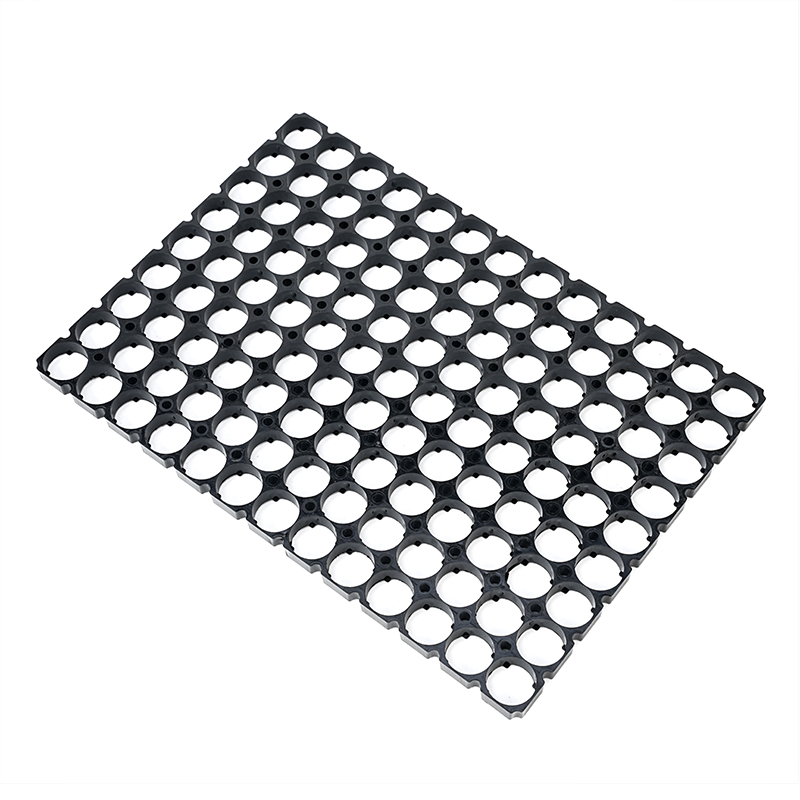
The 32650 9x13 Battery Cell Holder Mounting Bracket is a specialized battery assembly component designed to organize, position, separate, and mechanically support cylindrical 32650 battery cells. It is commonly considered for battery pack structures that require a stable cell arrangement, consistent spacing, reliable mechanical support, and improved structural organization. The 9x13 configuration refers to a holder arrangement capable of accommodating a large matrix of cylindrical cells, making this type of battery cell holder suitable for high-cell-count battery assemblies and customized energy storage structures.
A battery cell holder mounting bracket is more than a simple plastic support. During battery pack assembly, cylindrical cells need to remain correctly positioned so that they do not move excessively, contact neighboring components unintentionally, or place unnecessary mechanical stress on electrical connections. A properly designed holder can provide a defined cell position while helping maintain spacing between adjacent cells.
The 32650 cylindrical cell format is larger than many commonly used cylindrical battery formats. Because of its larger physical dimensions, a 32650 battery pack requires a holder system with suitable mechanical strength, dimensional stability, heat resistance, and impact resistance. A 32650 9x13 Battery Cell Holder Mounting Bracket can provide an organized structural interface for these requirements.
This product category is commonly associated with ABS+PC material construction. ABS+PC, also known as an acrylonitrile butadiene styrene and polycarbonate blend, can provide a useful balance between rigidity, toughness, impact resistance, processing performance, and temperature resistance. When a flame-retardant grade is selected, the material can also provide enhanced resistance to ignition and flame propagation. A halogen-free flame-retardant V-0 material specification is particularly relevant when the battery assembly requires a flame-retardant structural component without relying on halogen-containing flame-retardant systems.
The holder described here is designed as a vertical holder structure. A VerticalHolder configuration can help maintain the orientation of cylindrical cells and simplify the arrangement of multiple battery cells inside a battery module or pack. Depending on the mechanical design, the holder can also contribute to ventilation pathways, cell separation, cable routing, module reinforcement, and assembly positioning.
Another important feature is customization. Random customization may refer to flexible customization of holder dimensions, hole arrangements, cell spacing, mounting structures, external geometry, or other mechanical details according to a particular battery pack design. Customization can be useful when the battery assembly does not follow a standard enclosure size or when the designer needs to accommodate different electrical layouts and mechanical interfaces.
The no-assembly characteristic is also valuable in battery manufacturing. A holder supplied as an integrated component can reduce the number of separate parts required during installation. This can simplify handling, reduce assembly steps, and improve consistency during battery pack production.
The holder is also designed to resist deformation. Good dimensional stability is important because a battery cell holder must retain its intended geometry during transportation, assembly, operation, and exposure to changing environmental conditions. A deformed holder may result in uneven cell spacing, misalignment, increased mechanical stress, or difficulties during battery pack installation.
This article provides a comprehensive industry-oriented overview of the 32650 9x13 Battery Cell Holder Mounting Bracket, including its definition, structure, materials, performance characteristics, applications, design considerations, customization possibilities, installation principles, maintenance considerations, and selection criteria.
A 32650 battery cell holder is a mechanical support structure designed specifically around the dimensions and geometry of 32650 cylindrical cells. The holder typically contains cylindrical openings or positioning features that keep individual cells separated and aligned.
The main purpose of a battery cell holder is mechanical organization. Batteries assembled from many cylindrical cells require consistent positioning because the cells must occupy a defined area inside a module or enclosure. Without a suitable holder, cylindrical cells can shift, rotate, or press against adjacent components.
A battery cell holder may be used on one side of a battery module or as part of a two-sided structure. In larger battery packs, multiple holder sections can be combined to create a rigid cell matrix.
The 32650 format is particularly suitable for applications where designers require relatively large cylindrical cells. Because the cells are larger than many smaller cylindrical formats, the holder must provide adequate wall thickness, mechanical strength, and dimensional stability.
A 32650 cell holder may be designed for different assembly configurations. The 9x13 designation indicates a matrix arrangement with nine cells in one direction and thirteen cells in another direction, resulting in a theoretical matrix of 117 cell positions when every position is populated.
However, a 9x13 holder does not necessarily have to be used with every position populated. Battery designers may use customized configurations depending on electrical requirements, available enclosure space, voltage targets, capacity requirements, thermal considerations, and module architecture.
The holder is therefore both a positioning component and a structural component.
The 9x13 configuration is important because it provides a high-density arrangement for cylindrical battery cells. If all 117 positions are used, the holder can support a large number of 32650 cells in a structured matrix.
A regular matrix arrangement provides several mechanical advantages. First, it establishes predictable cell spacing. Second, it helps maintain a repeatable overall module geometry. Third, it makes the battery assembly easier to inspect and manage.
A 9x13 cell matrix can also make electrical interconnection planning more systematic. Busbars, Nickel Strips, copper interconnects, or other electrical connection systems can be designed around predictable cell positions.
The mechanical holder itself does not determine the electrical connection method. Electrical connections must be designed separately according to the battery chemistry, current requirements, welding method, protection architecture, and applicable safety requirements.
The holder's role is primarily mechanical.
A well-designed 9x13 holder can help ensure that:
Each cell remains in its designated position.
Neighboring cells maintain controlled separation.
The overall battery module retains a regular geometry.
Cell movement is reduced during handling.
Interconnection components have a predictable mounting relationship.
The battery pack can be integrated into an enclosure more easily.
The module can be inspected and serviced more systematically.
The exact spacing between cells should always be established from the actual cell dimensions, holder geometry, thermal requirements, insulation requirements, and enclosure design rather than assumed solely from the nominal cell designation.
The VerticalHolder configuration is intended to organize cylindrical battery cells in a vertical orientation or according to a vertically oriented mechanical structure.
Vertical cell positioning can be useful when the battery enclosure, module architecture, or cooling arrangement benefits from a consistent cell direction. A vertical holder can also help create an organized internal structure in which cells are arranged at predetermined positions.
A VerticalHolder design may include:
Cylindrical cell openings
Cell positioning walls
Reinforcing ribs
Mounting points
Separation structures
Support surfaces
Ventilation gaps
Interlocking features
Enclosure connection points
Alignment features
The specific geometry varies according to the intended battery module.
One of the most important considerations is dimensional accuracy. If a cell opening is excessively large, the cell may move inside the holder. If the opening is excessively tight, installation may become difficult and the holder could exert unnecessary mechanical stress on the cell casing.
The holder should therefore be designed with an appropriate dimensional tolerance.
Material selection is a major factor in the performance of a battery cell holder mounting bracket.
For this product category, ABS+PC is a practical material option because it combines characteristics from two engineering thermoplastics.
ABS can contribute rigidity, processability, and surface quality, while polycarbonate can contribute toughness and impact resistance. A properly formulated ABS+PC blend can provide a useful combination of mechanical and thermal properties.
A battery cell holder should not be evaluated only by its initial appearance. Its material should also be considered in relation to:
Mechanical strength
Impact resistance
Heat resistance
Low-temperature resistance
Dimensional stability
Chemical resistance
Flame retardancy
Electrical insulation
Processing consistency
Environmental exposure
Long-term structural performance
Material quality is especially important in battery assemblies because the holder may experience repeated thermal cycles and mechanical vibration.
ABS+PC is an engineering plastic blend widely used for components requiring a balance of strength, toughness, processability, and appearance.
ABS contributes several useful characteristics, including:
Good rigidity
Good processing behavior
Good surface finish
Good dimensional stability
Resistance to common mechanical handling stresses
Polycarbonate contributes:
High impact resistance
Good toughness
Better temperature performance than many conventional plastics
Good dimensional stability
Resistance to cracking under appropriate conditions
The resulting ABS+PC blend can be engineered for applications where ordinary commodity plastics may not provide sufficient mechanical performance.
For battery cell holders, ABS+PC can be particularly useful because the holder needs to remain mechanically stable while supporting multiple cylindrical cells.
The exact properties of ABS+PC depend on the specific resin grade, formulation, processing conditions, wall thickness, additive package, and manufacturing process. Therefore, technical specifications should always be confirmed against the actual material grade being used.
A halogen-free flame-retardant V-0 material specification is an important characteristic for applications where flame resistance is required.
The V-0 classification is associated with UL 94 vertical flammability testing. In general terms, a material achieving V-0 demonstrates controlled burning behavior under the specified test conditions.
Halogen-free flame retardancy refers to a flame-retardant formulation that does not rely on halogen-based flame-retardant chemistry. This characteristic can be desirable for electrical and battery-related components where designers prefer halogen-free materials.
It is important to distinguish between flame-retardant plastic and fireproof construction. A V-0 rating applies to the tested material under defined test conditions. It does not mean that an entire battery pack is fireproof or that the holder alone can prevent battery thermal events.
The holder's flame-retardant material can nevertheless contribute to the overall material strategy of a battery assembly.
When specifying a flame-retardant holder, engineers should confirm:
The exact resin grade
UL 94 classification
Test thickness
Certification status
Halogen-free requirements
Operating temperature range
Mechanical properties
Chemical compatibility
Long-term aging performance
Flame-retardant material is particularly relevant to electrical insulation components and battery pack structural parts.
A flame-retardant battery cell holder can help reduce the tendency of the plastic structure to sustain combustion under specified test conditions. This can provide an additional layer of material performance in electrical and energy-storage assemblies.
However, flame retardancy should be considered as one component of a complete safety architecture. Battery safety also depends on cell chemistry, cell quality, battery management systems, electrical protection, thermal management, enclosure design, insulation, fusing, wiring, and manufacturing quality.
The holder itself is not a substitute for electrical or thermal protection.
Battery systems may be exposed to cold environments during transportation, storage, outdoor operation, or seasonal temperature changes.
A suitable battery cell holder should maintain sufficient mechanical integrity at its intended low operating temperature.
Low-temperature resistance can be particularly important because some plastics become more brittle as temperature decreases. A brittle holder may be more vulnerable to cracking during impact, installation, or vibration.
ABS+PC can provide better toughness than many basic plastics, although the exact low-temperature performance depends on the grade and formulation.
When selecting a holder for cold environments, designers should evaluate:
Minimum operating temperature
Impact strength at low temperature
Brittleness
Dimensional changes
Repeated thermal cycling
Compatibility with the battery enclosure
Long-term aging
A holder intended for indoor battery equipment may have different requirements from one intended for outdoor energy storage equipment.
Heat resistance is another important characteristic of a battery cell holder.
Battery cells generate heat during charging and discharging. The amount of heat depends on current, internal resistance, cell chemistry, temperature, state of charge, and operating conditions.
The holder may therefore experience elevated temperatures during normal operation.
A heat-resistant ABS+PC holder can help maintain structural integrity when exposed to the designed operating temperature range. The material should resist excessive softening, deformation, warping, or loss of mechanical strength.
Heat resistance is especially important in densely packed battery modules because the holder may be located close to many heat-generating cells.
However, the holder should not be treated as a thermal management device by itself. Effective thermal management may require:
Air channels
Heat-conductive structures
Thermal interface materials
Heat sinks
Cooling plates
Fans
Liquid cooling systems
Thermal monitoring
The holder should be designed to work with the overall thermal architecture.
Impact resistance describes the ability of the material and structure to tolerate sudden mechanical forces without cracking or breaking.
Battery packs can experience impact during:
Transportation
Installation
Equipment movement
Assembly
Vibration
Accidental drops
Mechanical shock
The holder helps protect cell positioning during such events by maintaining a structured arrangement.
ABS+PC is commonly selected where improved impact resistance is required. Polycarbonate contributes substantial toughness to the blend, while ABS helps maintain rigidity and processing performance.
The actual impact resistance depends on the material grade and structural design. Sharp corners, thin walls, excessive molding stress, and poor processing can reduce the practical durability of a plastic component.
Rounded corners, suitable wall thickness, reinforcing ribs, and appropriate molding parameters can improve mechanical performance.
Battery systems may encounter various chemicals during manufacturing, operation, cleaning, transportation, or maintenance.
A battery cell holder should therefore have appropriate resistance to substances that may be present in its intended environment.
Potential exposure can include:
Oils
Cleaning agents
Industrial fluids
Electrolyte-related contaminants
Adhesives
Solvents
Moisture
Dust
Environmental pollutants
The chemical resistance of ABS+PC varies depending on the chemical, concentration, temperature, exposure time, and material formulation.
Therefore, chemical compatibility should always be verified through actual testing when a specific chemical environment is expected.
The phrase "excellent chemical resistance" should be understood as a design objective or general material characteristic rather than an unlimited resistance to every chemical.
Dimensional stability is essential for a battery cell holder.
A holder that changes shape significantly can affect cell alignment and module geometry. Deformation can result from excessive heat, mechanical loading, moisture, molding stress, chemical exposure, or long-term aging.
A properly designed ABS+PC holder can provide good resistance to deformation under appropriate operating conditions.
Several factors contribute to deformation resistance:
Material formulation
Wall thickness
Reinforcing rib design
Support geometry
Mold design
Processing temperature
Cooling conditions
Operating temperature
Mechanical loading
Environmental exposure
A good holder design distributes mechanical loads rather than concentrating stress at isolated points.
Random customization can be interpreted as flexible or arbitrary customization according to the requirements of a particular battery pack.
Customization may include:
Number of cell positions
Cell spacing
Holder length
Holder width
Holder height
Mounting holes
Screw positions
Fixing clips
Reinforcement ribs
Cable passages
Ventilation openings
Interlocking features
Enclosure interfaces
Identification markings
Surface texture
Material grade
Color
Structural thickness
Custom designs are particularly useful for battery manufacturers and system integrators working with non-standard enclosures.
Instead of forcing a battery module into a standard holder, the holder can be developed around the actual mechanical architecture.
This can improve space utilization and simplify integration.
A no-assembly holder is supplied as an integrated component rather than requiring the customer to construct the holder from multiple separate pieces.
This can provide several practical advantages.
First, it reduces the number of individual components handled during production.
Second, it can simplify installation.
Third, it can reduce the possibility of assembly errors.
Fourth, it can improve consistency between battery modules.
A ready-to-install holder can be particularly useful in production environments where assembly time and repeatability are important.
The no-assembly concept does not mean that the battery pack itself requires no assembly. Electrical connections, protection systems, enclosure components, wiring, and other parts still require appropriate manufacturing processes.
The mechanical structure of a 32650 9x13 Battery Cell Holder Mounting Bracket typically consists of multiple interconnected cell-positioning features.
The main structural functions include:
Each opening or support area positions one cylindrical cell.
The holder maintains controlled spacing between neighboring cells.
Ribs and walls increase stiffness while reducing unnecessary material.
Mounting interfaces connect the holder to an enclosure, frame, module, or adjacent structural component.
Alignment features help ensure that multiple holder sections remain correctly positioned.
Open areas can help create airflow channels when the overall module design requires air cooling.
Plastic separation between cells and conductive structural components can help support the electrical insulation strategy.
The exact geometry should always be designed according to the cell dimensions and battery architecture.
Cell spacing is one of the most important design parameters.
If cylindrical cells are positioned too closely, thermal expansion, mechanical movement, or manufacturing tolerances may create unwanted contact or interference.
If cells are spaced too far apart, the battery module becomes unnecessarily large.
An optimized holder therefore balances:
Cell diameter
Cell tolerance
Required electrical insulation
Thermal requirements
Mechanical stability
Enclosure dimensions
Manufacturing tolerance
Assembly method
The holder should maintain a repeatable distance between adjacent cells.
For large cell matrices such as 9x13, even a small dimensional error repeated across many positions can affect the total module dimensions.
A battery cell holder is not usually the primary thermal management component, but its design can influence thermal behavior.
Open structures may provide pathways for air movement.
Spacing between cells can help prevent direct contact between neighboring cell surfaces.
Structural ribs can be positioned to provide mechanical strength without unnecessarily blocking ventilation.
For forced-air cooling systems, holder openings can be aligned with airflow paths.
For liquid-cooled battery systems, the holder must be compatible with the cooling plate or thermal interface structure.
Thermal design should consider the entire battery system rather than the holder in isolation.
Important factors include:
Heat generation
Cell-to-cell spacing
Airflow direction
Cooling method
Ambient temperature
Maximum cell temperature
Temperature uniformity
Thermal expansion
Material temperature limits
The holder is commonly made from electrically insulating plastic, which can help separate cylindrical cells from surrounding conductive structures.
However, the holder should not automatically be considered the sole insulation barrier.
A complete battery assembly may require additional Insulating Materials such as:
Fish paper
PET film
Polyimide tape
Electrical insulation sheets
Protective films
Electrical insulation design must consider voltage, creepage distance, clearance, mechanical movement, environmental conditions, and applicable safety standards.
The holder can provide mechanical separation while additional Insulation Materials provide targeted electrical protection.
The 32650 9x13 Battery Cell Holder Mounting Bracket can be considered for a variety of cylindrical battery pack structures.
Potential applications include:
Rechargeable battery packs
Energy storage modules
Portable power systems
Backup power equipment
Industrial battery systems
Electric mobility systems
Solar energy storage
Off-grid energy systems
Battery testing fixtures
Battery prototype assemblies
Custom lithium battery modules
The suitability of a particular holder depends on the actual cell, battery chemistry, electrical configuration, operating environment, and enclosure.
Energy storage systems often contain many battery cells arranged into modules.
A structured cell holder can simplify the mechanical organization of a high-cell-count battery module.
The holder can help maintain consistent cell positioning while allowing engineers to develop an organized arrangement for:
Electrical interconnection
Thermal management
Monitoring
Module mounting
Enclosure integration
Maintenance access
For stationary energy storage, dimensional stability and long-term mechanical performance can be especially important because the battery system may remain assembled for extended periods.
In manufacturing environments, repeatability is critical.
A 32650 9x13 holder can serve as a positioning fixture during module assembly.
The holder can help workers or automated equipment maintain the intended cell arrangement.
Potential manufacturing benefits include:
Faster cell positioning
Reduced manual alignment
Better repeatability
Reduced component movement
Easier inspection
Improved module consistency
Simplified enclosure installation
A standardized holder can also make production processes more predictable.
Not every battery pack follows a standard format.
Custom battery packs may have unusual enclosure shapes, special mounting points, different cell counts, or specific cooling requirements.
In such cases, a customized 32650 cell holder can be designed around the actual system.
Customization can involve both the internal cell matrix and external mounting geometry.
For example, a designer may need:
A specific number of cell positions
Unequal edge spacing
Special mounting brackets
Additional reinforcement
Cable openings
BMS clearance
Cooling channels
Enclosure fixing points
The ability to customize the holder can make it easier to integrate cylindrical cells into complex products.
A well-designed holder provides several structural advantages.
Cells remain in defined positions instead of moving freely.
A regular matrix makes the battery pack easier to understand and assemble.
The holder limits unwanted cell movement.
Mounting features allow the holder to connect to the battery enclosure or module frame.
Every cell position follows the same geometric relationship.
A structured arrangement makes visual inspection more straightforward.
Customized holders can be designed around the available enclosure dimensions.
Good surface quality is useful for molded battery holder components.
A smooth and consistent surface can help with:
Appearance
Cleaning
Handling
Dimensional inspection
Mold release
Reduced surface defects
ABS+PC can provide a good surface finish when processed under suitable molding conditions.
Surface quality should not be evaluated only visually. Critical mechanical dimensions and functional features should also be inspected.
Dimensional stability is one of the most important characteristics for a cell holder.
A holder may be exposed to:
Temperature changes
Mechanical stress
Vibration
Long-term loading
Moisture
Chemical exposure
Good dimensional stability helps preserve the designed cell spacing and mounting geometry.
In a 9x13 matrix, dimensional stability becomes particularly important because the total module size depends on the accumulated spacing between many cells.
Even small deviations can become significant across a large matrix.
Design robustness refers to the ability of the holder structure to maintain its intended function under normal mechanical and environmental conditions.
A robust holder should account for:
Cell weight
Installation forces
Handling forces
Vibration
Shock
Thermal expansion
Material shrinkage
Manufacturing tolerances
Mounting loads
Reinforcing ribs can increase stiffness without requiring an excessively thick solid wall.
Rounded corners can reduce stress concentration.
Balanced wall thickness can help reduce molding distortion.
Well-positioned mounting points can distribute loads across the structure.
When selecting a holder material, several characteristics should be considered together.
Suitable for applications requiring a balance of toughness, rigidity, impact resistance, and thermal performance.
Can provide good rigidity and processability but may not offer the same impact and temperature performance as suitable ABS+PC grades.
Provides high impact resistance and good temperature performance but may have different processing and chemical compatibility characteristics.
Can provide strong mechanical performance but absorbs more moisture than some other engineering plastics, which may affect dimensional stability.
Can offer useful electrical and thermal characteristics in certain applications.
The final material should be selected according to the actual battery environment rather than by material name alone.
Injection molding is a common manufacturing method for plastic battery holders.
The basic process includes:
Plastic material preparation
Material drying when required
Injection into a designed mold
Filling and pressure control
Cooling
Mold opening
Part ejection
Inspection
Packaging
Mold design has a significant influence on the quality of the final holder.
Important molding considerations include:
Gate location
Cooling channels
Draft angle
Wall thickness
Shrinkage
Warpage
Weld lines
Ejection structure
Dimensional tolerance
A properly engineered injection molding process can provide high repeatability for large-volume production.
Quality inspection should cover both appearance and function.
Typical inspection areas include:
Overall dimensions
Cell opening dimensions
Cell spacing
Mounting hole position
Wall thickness
Surface defects
Cracks
Deformation
Flash
Burrs
Color consistency
Material identification
Flame-retardant grade
Mechanical integrity
For customized products, inspection should also verify the customer-specific drawing or specification.
The following specification framework can be used for product-page or industry documentation purposes. Actual values should be confirmed against the specific production model.
| Specification Item | General Description |
|---|---|
| Product Type | 32650 Battery Cell Holder Mounting Bracket |
| Configuration | 9x13 Cell Matrix |
| Holder Orientation | VerticalHolder |
| Cell Type | 32650 Cylindrical Battery Cell |
| Material | ABS+PC |
| Flame Retardant | Halogen-Free Flame Retardant |
| Flame Rating | V-0 Grade When Specified |
| Structure | Integrated Cell Positioning Holder |
| Customization | Flexible Custom Design |
| Assembly | No Assembly Required for Holder Component |
| Impact Resistance | High Impact Resistance Material Option |
| Heat Resistance | Suitable for Designed Operating Conditions |
| Low Temperature Resistance | Suitable for Specified Low-Temperature Conditions |
| Chemical Resistance | Good to Excellent Depending on Chemical Exposure |
| Dimensional Stability | Designed for Stable Cell Positioning |
| Deformation Resistance | High Structural Stability |
| Application | Cylindrical Battery Pack Assembly |
| Installation | Cell Positioning and Module Mounting |
| Manufacturing | Injection Molded Plastic Structure |
| Color | Customizable Depending on Requirement |
The specification table above is a general product-information framework rather than a certification document.
The actual product specification should confirm:
Exact cell dimensions
Actual holder dimensions
Material grade
Flame-retardant certification
Operating temperature
Mechanical strength
Chemical compatibility
Tolerance
Color
Weight
Mounting configuration
Technical specifications should be verified against the final drawing and material data sheet before mass production.
Installing a battery cell holder requires attention to mechanical alignment and cell compatibility.
Before installation, verify that the cells match the holder dimensions.
The holder should be inspected for:
Cracks
Warpage
Flash
Damaged openings
Missing mounting features
Deformation
Cells should be inserted using appropriate force.
Excessive force should be avoided because it may damage the holder or cell.
The cell body should sit securely within the designated position.
After installation, inspect the entire module to ensure that:
Cells are aligned.
No holder section is cracked.
Cell spacing is consistent.
Mounting points are secure.
Electrical insulation is correctly installed.
Interconnection components do not create unintended mechanical stress.
Electrical assembly should be performed by qualified personnel following the applicable battery manufacturing procedures.
A holder should always be matched to the actual cell dimensions.
The designation "32650" identifies a general cylindrical cell format, but actual cell dimensions and tolerances can vary between cell designs.
Before ordering or producing a holder, engineers should confirm:
Cell diameter
Cell length
Terminal geometry
Positive terminal design
Negative terminal design
Insulation sleeve thickness
Dimensional tolerance
The holder should accommodate the complete cell assembly rather than only the nominal bare cell dimensions.
Battery cell holders contain multiple repeated openings.
A small dimensional error in one opening may appear insignificant, but the same error repeated across 117 positions can influence the overall module geometry.
Dimensional accuracy therefore affects:
Cell fit
Cell alignment
Module size
Enclosure fit
Electrical interconnection
Cooling design
Mechanical stability
Quality-controlled molding and appropriate inspection procedures are important for high-count cell matrices.
Battery modules used in vehicles, mobile equipment, industrial machinery, or portable systems may experience vibration.
A suitable holder can reduce relative movement between cells.
Vibration-resistant design may involve:
Tight but appropriate cell positioning
Reinforcing ribs
Strong mounting points
Interlocking structures
Adequate wall thickness
Controlled clearance
The holder should be considered as part of the complete vibration-management system.
Additional cushioning or elastomeric materials may be required when severe vibration is expected.
Mechanical shock can occur during transportation, installation, or equipment operation.
The holder should maintain cell positioning during expected shock loads.
ABS+PC can provide useful impact resistance, while the geometry of the holder determines how impact loads are distributed.
A robust design avoids brittle thin sections and unnecessary stress concentrations.
For critical battery applications, mechanical testing should be performed under representative conditions.
Although ABS+PC can provide useful environmental resistance, the battery pack's overall environmental protection depends on the enclosure and sealing system.
A holder may be exposed to humidity, condensation, dust, and temperature fluctuations.
Environmental design should therefore consider:
Moisture
Humidity
Dust
Salt exposure
UV exposure
Cleaning chemicals
Temperature cycling
For outdoor applications, the material and complete enclosure should be tested according to the intended environmental conditions.
Chemical resistance should be evaluated based on actual exposure.
Different chemicals can affect plastics in different ways.
Factors include:
Chemical concentration
Temperature
Exposure duration
Mechanical stress
Surface condition
Material grade
A plastic that performs well with one chemical may not perform equally well with another.
For this reason, actual chemical compatibility testing is recommended when the battery module operates in a chemically demanding environment.
Flame-retardant holder materials can contribute to safer material selection.
However, battery safety is a system-level engineering problem.
A battery pack should also incorporate suitable:
Battery management systems
Overcurrent protection
Short-circuit protection
Thermal monitoring
Appropriate insulation
Mechanical protection
Cell balancing
Enclosure protection
Manufacturing controls
The holder should be regarded as a mechanical and material component within this larger safety system.
Plastic cell holders generally require limited maintenance when properly installed.
Routine inspection may include checking:
Cracks
Deformation
Loose mounting points
Cell movement
Damaged insulation
Contamination
Signs of overheating
If a holder becomes cracked or significantly deformed, it should be evaluated before the battery system continues operation.
Cleaning should use methods compatible with the material and battery assembly.
Aggressive solvents should not be used without chemical compatibility verification.
Unused holders should be stored in suitable conditions.
Recommended general considerations include:
Keep the parts dry.
Avoid prolonged direct sunlight.
Protect from excessive heat.
Avoid heavy compression.
Prevent unnecessary mechanical impact.
Keep away from incompatible chemicals.
Maintain original packaging when possible.
Proper storage helps preserve dimensional stability and surface quality.
Because battery holders can contain multiple thin ribs and positioning structures, packaging should prevent deformation during transportation.
Suitable packaging may include:
Protective bags
Dividers
Corrugated cartons
Molded protective inserts
Stacking supports
Heavy objects should not be placed on top of the holder unless the packaging has been designed to withstand the load.
Customized holders with delicate structures may require specially designed packaging.
The product concept offers multiple potential advantages for cylindrical battery pack assembly.
A 9x13 configuration creates a structured cell matrix.
The VerticalHolder structure supports organized cylindrical cell placement.
The material combines rigidity and toughness.
Halogen-free flame-retardant V-0 material can be selected where required.
The engineering plastic structure can provide good resistance to mechanical impact.
The material can maintain useful mechanical performance within its specified temperature range.
Appropriate ABS+PC grades can retain useful toughness under cold conditions.
The material can provide good resistance to many commonly encountered substances when properly selected.
The holder is designed to maintain cell positioning.
The geometry can be adapted to different battery architectures.
An integrated holder reduces separate assembly operations.
The structural design can help maintain the intended geometry.
Loose cylindrical cells can be difficult to organize in a large battery module.
Without a holder, cells may:
Move during handling
Rotate
Become misaligned
Increase wiring complexity
Create uneven spacing
Make module inspection more difficult
A dedicated cell holder creates a repeatable mechanical framework.
This does not eliminate the need for proper electrical insulation, interconnection, thermal management, or enclosure protection, but it can simplify the mechanical portion of battery pack construction.
A customized holder can help optimize the available enclosure volume.
Instead of leaving unnecessary gaps between cells, designers can establish a controlled arrangement based on the actual requirements.
Space optimization can improve the relationship between:
Cell count
Module dimensions
Cooling paths
BMS space
Wiring space
Structural support
Enclosure volume
However, maximum packing density should never be the only objective. Adequate electrical insulation, thermal management, mechanical clearance, and safety margins must also be considered.
The holder is one element within a larger battery architecture.
A typical cylindrical battery pack may contain:
Cylindrical cells
Cell holders
Electrical interconnects
Insulation materials
BMS
Fuses
Wiring
Connectors
Enclosure
Thermal management components
Cushioning materials
Sealing components
Mounting hardware
The cell holder provides the mechanical foundation for organizing the cylindrical cells.
Design for manufacturing is important when developing a custom holder.
A mold-friendly design should consider:
Uniform wall thickness
Appropriate draft angles
Reasonable rib thickness
Proper corner radii
Efficient gate positioning
Controlled shrinkage
Easy ejection
Reduced warpage
A complicated design may increase mold cost and production difficulty.
Therefore, customization should balance functional requirements with manufacturability.
The holder should make cell installation straightforward.
Useful design characteristics can include:
Clear cell openings
Consistent spacing
Appropriate insertion clearance
Easy alignment
Strong mounting points
Visual orientation features
Accessible electrical connection areas
A good design can reduce assembly time and lower the risk of positioning errors.
Material consistency affects product quality.
Variations in material formulation, moisture content, processing temperature, or molding conditions can influence:
Mechanical strength
Surface appearance
Dimensions
Warpage
Impact resistance
Flame-retardant performance
For high-volume production, process control is therefore important.
Material traceability can also help support quality management.
When developing a customized holder, engineers commonly need to define:
What exact 32650 cell dimensions will be used?
How many cells are required?
Is the configuration exactly 9x13?
Is the holder vertical?
What enclosure dimensions are available?
What mounting points are required?
Is flame retardancy required?
Is halogen-free material required?
What temperature range is expected?
What mechanical loads are expected?
Is forced-air cooling required?
Are additional insulation materials required?
What manufacturing volume is expected?
What dimensional tolerances are required?
Are special colors or markings needed?
Answering these questions early can reduce design changes later.
When selecting a 32650 9x13 Battery Cell Holder Mounting Bracket, consider the following factors.
Confirm the actual cell diameter and length.
Confirm the required row and column arrangement.
Determine whether a VerticalHolder structure is appropriate.
Confirm whether ABS+PC meets the mechanical and environmental requirements.
Confirm whether halogen-free V-0 performance is required.
Determine the minimum and maximum operating temperatures.
Evaluate vibration, impact, compression, and mounting loads.
Identify possible cleaning agents, oils, solvents, and environmental chemicals.
Determine whether standard geometry is sufficient or a customized structure is necessary.
Confirm whether an integrated no-assembly holder is preferred.
Check mounting holes, overall dimensions, and clearances.
It is a mechanical holder designed to organize 32650 cylindrical battery cells in a 9x13 matrix.
A complete 9x13 matrix provides 117 cell positions.
VerticalHolder generally describes a holder configuration designed to position cylindrical cells vertically or in a vertically oriented structure.
The described product uses ABS+PC engineering plastic.
A halogen-free flame-retardant V-0 material can be specified for suitable versions.
Suitable ABS+PC grades provide good impact resistance and toughness.
Suitable ABS+PC grades can provide useful heat resistance within their specified operating range.
Yes. Holder dimensions, cell spacing, mounting structures, and other mechanical features can be customized according to project requirements.
The holder can be supplied as an integrated component without separate holder assembly.
A properly designed ABS+PC structure can provide good dimensional stability and resistance to deformation under appropriate conditions.
Outdoor suitability depends on the complete material grade, enclosure, temperature range, UV exposure, moisture protection, and other environmental requirements.
No. The holder can contribute to mechanical separation and insulation, but additional electrical insulation may be required.
The holder can be designed with spacing and openings that support airflow, but it is not itself a complete cooling system.
Not automatically. Actual cell dimensions and tolerances must be checked before selecting or producing the holder.
Engineers designing around a 32650 9x13 holder should consider the complete mechanical stack-up.
This includes:
Cell diameter
Cell length
Holder opening
Holder wall
Insulation sleeve
Busbar or nickel strip
PCB or BMS clearance
Enclosure wall
Thermal interface
Cushioning
Fastener clearance
Stack-up analysis is important because every component contributes to the final module dimensions.
A holder may fit the nominal cell dimensions but still create interference when additional insulation or interconnection components are added.
Long-term reliability depends on both material and structure.
Important factors include:
Thermal cycling
Mechanical vibration
Repeated charging and discharging
Environmental exposure
Material aging
Chemical exposure
Installation stress
Long-term compression
A reliable holder should retain sufficient strength and dimensional stability over its expected service life.
For demanding applications, validation testing may include:
Temperature cycling
Impact testing
Vibration testing
Drop testing
Dimensional inspection
Flame testing
Chemical compatibility testing
Testing should be designed around the actual application.
Material selection can also be considered from an environmental perspective.
A durable holder can contribute to longer product life by maintaining the mechanical organization of the battery module.
Halogen-free flame-retardant material may also be selected where product specifications call for reduced use of halogen-based flame-retardant chemistry.
End-of-life treatment should follow the applicable recycling and waste-management requirements for engineering plastics and battery assemblies.
Battery cells must be handled separately according to relevant battery recycling and safety procedures.
Quality control should begin with raw material selection and continue through molding, inspection, packaging, and shipment.
A comprehensive quality process may include:
Incoming material inspection
Material identification
Mold inspection
First-article inspection
Dimensional inspection
Visual inspection
Functional fit testing
Flame-retardant verification where applicable
Mechanical testing
Packaging inspection
Consistent production is particularly important for large cell holders because a dimensional problem can affect many cell positions simultaneously.
As cylindrical battery systems evolve, holder designs are also becoming more sophisticated.
Future designs may increasingly integrate:
Improved ventilation
Lightweight reinforcement
Modular interlocking
Automated assembly compatibility
Better thermal pathways
Improved vibration control
Integrated cable management
Sensor positioning
BMS mounting interfaces
More efficient material use
The fundamental purpose remains the same: safely and consistently organize cylindrical battery cells within a larger battery architecture.
The 32650 9x13 Battery Cell Holder Mounting Bracket is a practical structural component for organizing large arrays of 32650 cylindrical battery cells. Its 9x13 configuration provides a structured matrix for high-cell-count battery assemblies, while the VerticalHolder design supports consistent cell positioning.
The use of ABS+PC provides a useful combination of rigidity, toughness, impact resistance, dimensional stability, and temperature performance. When a suitable halogen-free flame-retardant V-0 material grade is specified, the holder can also contribute to the flame-retardant material strategy of electrical and battery applications.
Important characteristics include low-temperature resistance, heat resistance, impact resistance, chemical resistance, structural robustness, and resistance to deformation. These characteristics make the holder suitable for consideration in battery modules, energy storage systems, custom cylindrical battery packs, industrial battery equipment, and other applications requiring organized cell positioning.
Customization is another important advantage. Cell spacing, mounting geometry, dimensions, reinforcement structures, ventilation openings, and other mechanical features can be adapted to different battery pack designs. A no-assembly integrated structure can further simplify manufacturing and reduce the number of separate mechanical components.
Nevertheless, the holder should always be considered as one component of a complete battery system. Proper electrical insulation, thermal management, battery management, overcurrent protection, mechanical protection, enclosure design, and manufacturing controls remain essential.
For product selection, the most important factors are actual 32650 cell dimensions, required 9x13 configuration, holder orientation, ABS+PC material grade, flame-retardant requirements, operating temperature, mechanical loading, environmental exposure, and enclosure integration.
A well-designed 32650 9x13 Battery Cell Holder Mounting Bracket can provide a reliable foundation for organized cylindrical battery assembly while supporting efficient manufacturing, consistent cell positioning, customized module design, and improved mechanical stability.
This website uses cookies to ensure you get the best experience on our website.



 Phone
Phone