

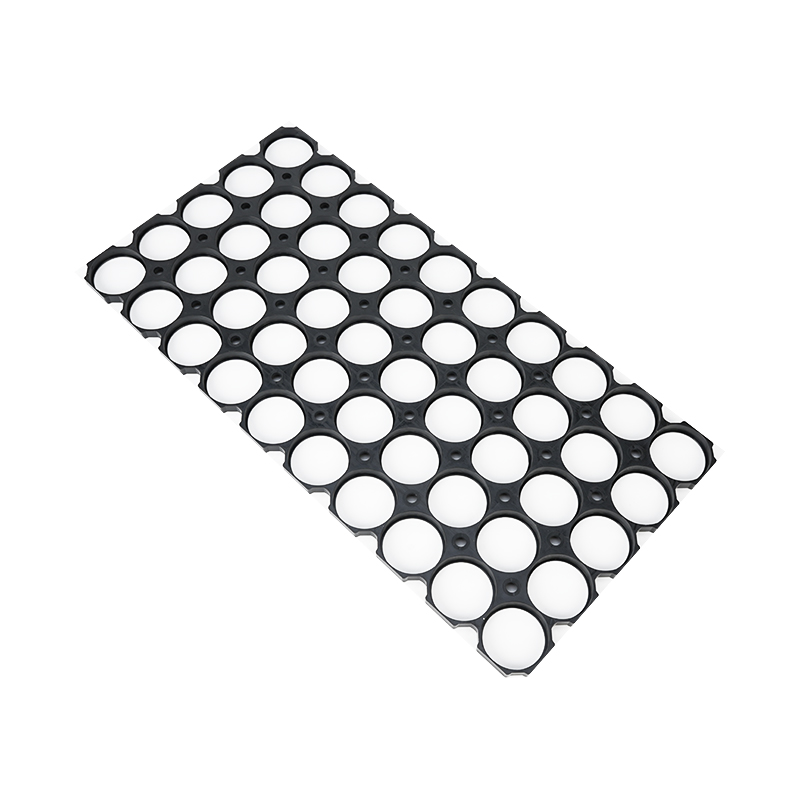
The Flame Retardant 5x10 Interlocking Battery Cell Holder Bracket is a modular mechanical support component developed for organized cylindrical battery assembly. Its primary purpose is to keep individual battery cells properly positioned, separated, and mechanically supported within a multi-cell battery structure. The interlocking format allows individual holder sections to be combined into larger assemblies, making the design suitable for battery packs with different physical dimensions and cell quantities.
Unlike a fixed single-piece battery tray, an interlocking battery cell holder can provide greater flexibility during battery pack development. Different holder sections may be arranged according to the required physical layout, enclosure dimensions, cell count, and mechanical architecture. This modular concept is particularly useful for prototypes, custom battery packs, replacement battery systems, portable power equipment, robotics, industrial electronics, and other applications involving cylindrical cells.
The 5x10 designation generally describes a holder arrangement containing five positions in one direction and ten positions in the other direction. When every position is occupied, a 5x10 configuration represents 50 battery-cell positions. The physical layout should be distinguished from the electrical series and parallel configuration because the holder determines mechanical organization rather than electrical characteristics.
A major feature of this holder concept is its durable plastic construction. Engineering thermoplastics can provide a useful combination of mechanical strength, low weight, dimensional stability, electrical isolation, and manufacturability. Depending on the application, flame-retardant grades of suitable plastics can be selected to improve resistance to ignition and flame propagation.
The holder also provides a compact method of keeping cylindrical batteries neatly organized. Instead of allowing individual cells to move freely inside an enclosure, each cell can be placed into a defined position. This can improve assembly consistency and create a more predictable mechanical structure.
The user-friendly interlocking design can also simplify assembly and disassembly. Individual sections can potentially be connected during pack construction and separated during maintenance, inspection, or prototype modification. The exact connection method depends on the holder geometry.
For professional battery designers and experienced DIY builders, the value of a modular cell holder extends beyond simple cell storage. It can provide a repeatable mechanical reference for cell positioning, enclosure design, insulation planning, electrical interconnection, and thermal management.
What Is a Flame Retardant Battery Cell Holder?
A flame-retardant battery cell holder is a plastic mechanical component designed to support and organize battery cells while using a material formulation intended to provide improved flame behavior.
The phrase "flame retardant" should be understood as a material characteristic rather than a guarantee that a battery holder is fireproof. Flame-retardant plastics can be engineered to reduce ignition tendency, slow flame propagation, or meet a specified flammability classification under defined test conditions.
The actual performance depends on the specific polymer grade, additives, component thickness, molding process, test method, and applicable standard.
For battery applications, flame-retardant construction can be one part of a broader safety-oriented mechanical design. A complete battery system requires additional measures for electrical protection, thermal management, insulation, mechanical protection, charging control, and fault management.
The cell holder itself primarily performs a mechanical function.
It keeps cells organized.
It reduces unnecessary movement.
It establishes consistent spacing.
It supports assembly.
It can create predictable mechanical clearances.
It may also help protect the cell body from direct contact with neighboring structural components.
Modular Design for Broad Applications
The modular design of a 5x10 interlocking battery holder is one of its most useful characteristics.
A conventional battery tray may be manufactured as one large component with a fixed number of cell positions. This approach can be effective for standardized battery products but may become restrictive when battery pack dimensions change.
An interlocking system takes a different approach.
Individual sections are designed to connect with other sections. This allows the mechanical structure to be expanded, reduced, rearranged, or adapted according to the intended battery pack.
A modular system may be useful when working with:
Different battery quantities
Different enclosure dimensions
Different row and column layouts
Prototype battery modules
Custom energy storage systems
Robotics battery assemblies
Portable power equipment
Industrial electronic equipment
Research and development projects
Replacement battery structures
Modularity can also simplify product development.
A designer can use a common holder concept across several battery products while changing the overall arrangement of the modules. This may reduce mechanical design complexity and make prototyping more efficient.
Adaptability to Different Battery Sizes
Battery packs can differ substantially in physical dimensions even when they use similar cylindrical cells.
A modular battery holder can provide flexibility for different battery configurations, provided that the holder cavity and retention geometry are compatible with the actual cell dimensions.
When evaluating compatibility, it is important to consider more than a nominal battery designation.
Relevant measurements include:
Cell diameter
Cell length
Cell wrap thickness
Terminal geometry
Terminal height
Protective sleeve dimensions
Dimensional tolerances
Required insertion clearance
Required retention clearance
A battery cell holder should provide an appropriate fit.
If the cavity is too tight, insertion may become difficult and the cell wrap could potentially be damaged.
If the cavity is excessively large, the cell may have too much movement.
The best mechanical fit depends on the holder design and the tolerances of the selected battery cell.
Durable Plastic Construction
A durable battery holder should maintain its mechanical function during normal handling, assembly, transportation, and operation.
Plastic construction provides several advantages.
It can be lightweight compared with metal structures.
It can be molded into complex geometries.
It can integrate interlocking features directly into the component.
It can provide electrical isolation between mechanically adjacent components.
It can be manufactured with repeated cell cavities.
Common thermoplastic families considered for battery holder applications include ABS, PP, PC, and PA nylon.
Each material has different characteristics.
ABS can provide a practical balance of rigidity, impact performance, dimensional stability, and molding performance.
PP is lightweight and offers useful chemical resistance and fatigue characteristics.
PC is known for high impact resistance and can be used when greater toughness is required.
PA nylon can provide strong mechanical properties and useful elevated-temperature performance, although moisture absorption should be considered for certain grades and environments.
The correct material should always be selected according to the intended operating conditions.
Long-Term Mechanical Performance
Long-term service life depends on more than the basic polymer name.
Important factors include:
Material grade
Component thickness
Mold design
Operating temperature
Environmental humidity
Mechanical loading
Vibration
Chemical exposure
UV exposure where applicable
Assembly stress
Interlocking force
Cell weight
Enclosure support
A properly designed holder should retain sufficient dimensional stability throughout its expected service environment.
The holder may be exposed to repeated mechanical loading during installation and maintenance. If the interlocking features are repeatedly engaged and disengaged, the connection geometry should be designed to tolerate the expected number of assembly cycles.
For demanding industrial applications, engineering evaluation should include actual environmental and mechanical testing.
Compact Battery Storage
The holder provides an organized structure for storing and supporting multiple cylindrical cells.
Instead of placing loose cells into an enclosure, the holder creates dedicated positions for each cell.
This can improve:
Physical organization
Assembly efficiency
Visual inspection
Cell identification
Mechanical stability
Space utilization
Pack consistency
A compact arrangement can be particularly useful when the enclosure has limited internal volume.
The holder allows the battery designer to establish a repeatable grid arrangement, making it easier to determine where other components will be installed.
The final compactness of a battery pack depends on the cell dimensions, holder geometry, spacing requirements, electrical insulation, thermal management, enclosure design, and safety clearances.
Compact does not necessarily mean that cells should be packed as closely as physically possible. Appropriate spacing and thermal considerations remain important.
Neat Cell Organization
A large number of cylindrical cells can become difficult to manage without a mechanical positioning system.
A 5x10 arrangement contains many individual cell positions. Without a holder, maintaining consistent alignment during assembly can require significant manual effort.
The holder creates a predefined structure.
Each cell can be assigned a position.
This provides a visual reference for assembly teams and can reduce confusion when working with complex battery layouts.
Organized cells can also make subsequent inspection easier.
A technician can identify each physical position and compare the actual arrangement with the intended design.
For prototype development, this can be especially useful because changes to the battery configuration can be documented and reproduced more easily.
Safety-Oriented Mechanical Design
A safety-oriented battery holder focuses on reducing mechanical risks associated with uncontrolled cell movement and accidental contact.
The holder can create separation between neighboring cells and maintain a consistent arrangement.
This may help reduce the likelihood of cells rubbing against each other or contacting unsuitable structural surfaces.
The holder can also help maintain clearance around electrical connection areas, depending on its geometry.
However, mechanical separation is only one part of battery safety.
The complete battery system should address:
Electrical insulation
Overcurrent protection
Short-circuit protection
Overcharge protection
Overdischarge protection
Temperature monitoring
Thermal management
Mechanical enclosure protection
Appropriate charging
Cell condition
Electrical connection integrity
A holder should therefore be considered a supporting safety component rather than an independent safety device.
Preventing Accidental Contact
One useful function of a cell holder is to reduce uncontrolled contact between neighboring components.
Cylindrical battery cells have conductive terminals and conductive external structures depending on their construction. Uncontrolled contact with other conductive materials can create electrical hazards.
A plastic holder can provide mechanical separation between cells and can help maintain a defined arrangement.
Additional insulation may still be necessary.
Depending on the battery design, insulating rings, Electrical Insulation Paper, polymer films, adhesive Insulation Materials, or other protective components may be required.
The exact insulation strategy should be determined by the battery electrical architecture and applicable requirements.
Protection Against Mechanical Damage
Battery cells are precision-manufactured energy-storage components and should not be treated as ordinary structural objects.
A cell holder can provide support around the cell body and reduce unnecessary movement.
This can help minimize mechanical contact with neighboring components.
Potential sources of mechanical stress include:
Vibration
Transportation
Impact
Repeated handling
Enclosure movement
Assembly pressure
Cable movement
Structural deformation
A suitable holder should support the cells without creating excessive localized pressure.
The holder should also avoid sharp edges or features that could damage protective cell wrapping during normal installation.
User-Friendly Assembly
Ease of assembly is an important advantage of a modular interlocking battery holder.
The holder can be assembled before cells are installed or configured around the intended cell arrangement, depending on the product design.
A user-friendly design can reduce assembly time by providing obvious connection points and predefined positions.
The modular structure may also allow sections to be removed without dismantling an entire battery module.
This is valuable during:
Prototype modification
Maintenance
Cell inspection
Mechanical troubleshooting
Pack redesign
Component replacement
Production line assembly
The actual assembly process should follow the holder manufacturer's dimensional and mechanical requirements.
Easy Disassembly and Quick Access
A battery holder that can be separated into modular sections can make access easier during development and maintenance.
For a prototype, a designer may need to change the number of cells or modify the physical arrangement.
A modular holder can make these changes more manageable than a permanently integrated tray.
For maintenance, removable sections can provide access to individual areas of the battery assembly.
However, disassembly of a battery pack should only be performed using appropriate safety procedures.
Lithium ion cells can contain substantial stored energy. Electrical isolation and controlled handling are essential during battery maintenance.
Interlocking Mechanism
The interlocking mechanism connects individual holder sections.
Possible connection approaches include molded clips, tabs, slots, rails, dovetail structures, pins, or other mechanical interfaces.
The exact design varies by product.
A successful interlocking system should provide enough retention to maintain the intended structure during normal handling while allowing practical assembly.
The interlocking connection should also be compatible with dimensional tolerances.
If the mechanism is too loose, the holder may separate unexpectedly.
If it is too tight, assembly may require excessive force.
Engineering validation can include repeated assembly and disassembly testing, vibration testing, and mechanical loading evaluation.
Modular Battery Pack Architecture
Modularity is increasingly useful in battery system development because different products require different energy capacities and physical configurations.
A single holder architecture can potentially be adapted to:
Small battery modules
Medium battery packs
Large battery assemblies
Prototype systems
Replacement battery structures
Custom equipment
This can simplify inventory management and mechanical development.
Instead of maintaining many completely different holder designs, a modular family can provide a common mechanical concept.
For custom battery manufacturers and development teams, modularity can also support faster prototyping.
5x10 Layout Concept
A 5x10 holder describes a grid-style physical arrangement.
Five positions in one direction and ten positions in another produce 50 available positions when fully populated.
The layout can provide a consistent geometric reference.
However, the holder's physical configuration should not be confused with electrical series-parallel architecture.
For example, 50 cells could theoretically be divided into different electrical combinations depending on the intended voltage and capacity.
The electrical arrangement should be designed independently from the mechanical holder.
This is important because the holder supports the physical structure while electrical components establish the actual battery circuit.
Physical Arrangement Versus Electrical Configuration
A battery holder does not determine:
Battery voltage
Battery capacity
Charging voltage
Maximum discharge current
BMS specification
Energy capacity
Those characteristics depend on the cells and electrical configuration.
The holder mainly determines:
Cell positions
Mechanical spacing
Physical orientation
Structural organization
Modular connections
This separation allows the same mechanical platform to potentially support different electrical designs, provided that the cell dimensions and electrical connection layout remain compatible.
Battery Cell Alignment
Accurate alignment can improve the appearance and mechanical consistency of a battery pack.
When cylindrical cells are aligned in a regular pattern, electrical connection components can be easier to position.
Alignment can also help simplify enclosure design because the designer can work from a predictable cell grid.
For automated or semi-automated production, repeatable cell positioning can be especially valuable.
A holder can provide a consistent mechanical reference that supports standardized assembly procedures.
Cell Retention
Cell retention refers to the ability of the holder to keep a cell within its intended position.
Retention can be created through cavity geometry, friction, clips, ribs, or other molded structures.
The ideal retention force depends on the cell dimensions and application.
Too little retention can allow movement.
Excessive retention can make installation difficult or potentially stress the cell.
The holder should therefore be evaluated using representative cells rather than relying only on nominal dimensions.
Battery Pack Vibration Considerations
Battery packs used in mobile or industrial equipment can experience vibration.
Vibration may originate from:
Motors
Fans
Pumps
Vehicles
Industrial machinery
Transportation
Mechanical equipment
A cell holder can reduce relative cell movement by keeping cells in defined positions.
However, overall vibration resistance depends on the complete assembly.
The enclosure, mounting points, holder interlocks, cell fit, electrical connections, insulation, and structural reinforcement all contribute to system-level mechanical performance.
For demanding applications, vibration testing should be conducted on the complete battery assembly.
Thermal Design Considerations
Battery cells generate heat during operation.
Thermal behavior depends on electrical current, cell chemistry, internal resistance, ambient conditions, charging conditions, discharge conditions, and battery architecture.
A cell holder can influence the available space around the cells.
Therefore, holder geometry should be considered during thermal design.
The holder should not unintentionally block required airflow or interfere with thermal interface materials.
If a battery requires active cooling, the holder should be designed together with the cooling system.
Potential cooling approaches can include:
Natural convection
Forced air
Thermal conduction
Heat spreaders
Thermal pads
Liquid cooling
Enclosure-based heat transfer
The appropriate method depends on the battery application.
Electrical Insulation and Mechanical Separation
Plastic holders can contribute to mechanical separation, but electrical insulation should be considered separately.
The actual dielectric requirements depend on:
Pack voltage
Cell configuration
Creepage distance
Clearance distance
Electrical connection geometry
Insulation material
Operating environment
Additional insulation components may be required around cell terminals, busbars, Nickel Strips, wiring, and enclosure interfaces.
A holder should therefore be integrated into a broader insulation strategy.
Flame Retardant Material Selection
When flame-retardant performance is required, the material grade should be specified rather than simply listing the polymer family.
For example, flame-retardant ABS is different from standard ABS.
Similarly, flame-retardant PC, PP, and PA formulations can have different characteristics from their standard counterparts.
Material selection should consider:
Flame classification
Heat resistance
Mechanical strength
Impact resistance
Dimensional stability
Chemical resistance
Moisture behavior
Processing requirements
Material certification and test data should be evaluated where required by the intended application.
ABS Battery Holder Applications
ABS is widely used in molded plastic components because of its balanced performance.
A suitable ABS grade can offer:
Good rigidity
Good molding performance
Useful impact resistance
Dimensional stability
Surface quality
Practical cost
Flame-retardant ABS can be selected when additional flammability performance is required.
ABS may be suitable for battery holder applications where the temperature and mechanical requirements fall within the selected material grade's capabilities.
Polypropylene Battery Holder Applications
PP is a lightweight thermoplastic with useful chemical resistance and fatigue characteristics.
Its relatively low density can help reduce component weight.
Certain PP formulations can be modified for flame-retardant applications.
When selecting PP for a battery holder, designers should consider temperature, rigidity, dimensional stability, and the expected mechanical load.
Polycarbonate Battery Holder Applications
PC is known for high impact resistance.
A PC-based holder may be considered when mechanical toughness is an important requirement.
Flame-retardant PC grades are available for applications requiring specific flammability performance.
The material's thermal characteristics and processing requirements should be considered during mold and product design.
PA Nylon Battery Holder Applications
PA nylon can provide strong mechanical properties and useful resistance to elevated temperatures.
Certain PA formulations are suitable for demanding engineering applications.
However, nylon can absorb moisture, which may affect dimensions and mechanical properties.
Therefore, the environmental conditions should be considered when using PA nylon for precision battery holder applications.
Injection Molding for Battery Holders
Injection molding is particularly suitable for producing battery cell holders because the process can replicate repeated cavities and integrated connection features.
A properly designed mold can create:
Cell cavities
Support ribs
Interlocking structures
Mounting features
Reinforcement sections
Alignment features
Injection molding can also provide consistent production when appropriate process controls are used.
Important production variables include:
Melt temperature
Injection pressure
Cooling rate
Mold temperature
Material moisture
Shrinkage
Warpage
Mold precision
These factors influence the final dimensional accuracy of the holder.
Dimensional Accuracy
Dimensional accuracy is important because a battery holder must interact with real cylindrical cells.
Critical dimensions can include:
Cavity diameter
Cavity depth
Cell spacing
Holder width
Holder length
Interlocking dimensions
Wall thickness
Mounting-hole dimensions
The actual tolerance requirements depend on the application.
For a prototype, moderate tolerance may be acceptable.
For automated production, tighter and more consistent dimensions may be necessary.
Space Efficiency
A modular holder can improve the organization of a battery enclosure.
By establishing predictable cell positions, it becomes easier to plan the available internal space.
However, space efficiency should not be evaluated only by the number of cells that fit.
The complete battery pack also requires room for:
Electrical insulation
Interconnection components
BMS
Wires
Fuses
Sensors
Cooling
Mechanical supports
Service clearances
A well-designed pack balances compactness with safety and maintainability.
Advantages for Battery Pack Prototyping
Battery prototyping often involves repeated changes.
A designer may change:
Cell quantity
Cell arrangement
Enclosure shape
Electrical configuration
Cooling strategy
Mounting method
A modular holder can make mechanical changes easier.
It provides a reusable structure that can be modified without redesigning every mechanical element.
This can shorten development cycles and help engineers evaluate different physical layouts.
Advantages for DIY Battery Projects
Experienced DIY battery builders may use modular cell holders to create organized battery structures.
The holder can provide:
Easier cell positioning
Cleaner physical layout
Better mechanical organization
Easier inspection
Modular expansion
Easier enclosure planning
DIY users should still understand that lithium ion battery assembly involves significant electrical and thermal energy.
The holder does not eliminate the need for appropriate battery protection.
Advantages for Industrial Battery Assembly
In industrial production, repeatability is important.
A standardized holder can provide a consistent reference for cell placement.
This can support:
Repeatable assembly
Visual inspection
Process standardization
Fixture design
Enclosure development
Quality control
Production training
The holder may also reduce manual positioning errors compared with assembling loose cells.
Application Areas
A flame-retardant 5x10 interlocking battery holder can potentially be used across multiple sectors.
Portable power equipment often requires compact and organized battery modules.
Robotic systems may require customized battery arrangements that fit limited internal space.
Industrial electronic equipment can benefit from structured battery modules.
Modular holders can support early-stage energy storage development.
The interlocking structure is suitable for custom mechanical configurations.
Engineers can use modular components to test alternative battery arrangements.
A modular holder can provide a mechanical framework for rebuilding compatible battery assemblies.
Design Benefits of Interlocking Components
Interlocking components can offer advantages over permanently fixed structures.
They can simplify:
Assembly
Storage
Transportation
Prototyping
Configuration changes
Maintenance
Component replacement
The modular format can also allow unused holder sections to be stored for future projects.
This can be useful for engineering departments and battery development teams working with multiple configurations.
Compact Storage Before Assembly
Battery holders themselves can often be stored as separate components before assembly.
Modular parts can occupy less organizational complexity than multiple complete battery trays designed for different cell counts.
Once required, the sections can be assembled into the desired configuration.
This approach can simplify component organization for workshops, development laboratories, and production environments.
Maintenance Benefits
A modular holder can make certain maintenance operations easier.
If a section becomes damaged, depending on the design, that section may potentially be replaced without replacing the entire mechanical assembly.
Modularity can also make inspection more convenient.
Technicians can access individual areas of the battery structure while maintaining an organized cell arrangement.
Maintenance procedures should always account for the electrical energy stored in lithium ion cells.
Battery Holder Cleaning
Plastic battery holders should generally be kept clean and free from contaminants.
Dust, metal particles, moisture, oils, and other contaminants can interfere with battery assembly.
Cleaning methods should be compatible with the selected plastic material.
Aggressive solvents should not be used unless material compatibility has been verified.
The battery cells themselves require separate handling procedures.
Environmental Resistance
The environmental resistance of a holder depends on its material and design.
Potential environmental conditions include:
High temperature
Low temperature
Humidity
Dust
Chemical exposure
Mechanical vibration
Storage conditions
A material that performs well in one environment may not be ideal in another.
For this reason, material selection should be linked directly to the expected operating conditions.
Product Inspection
Quality inspection of a molded battery holder can focus on both appearance and dimensions.
Typical checks may include:
Cell cavity consistency
Interlocking fit
Surface condition
Mold flash
Cracks
Warpage
Broken clips
Dimensional accuracy
Material consistency
Color consistency
Representative cells can be used to confirm practical fit.
Common Manufacturing Defects
Injection-molded plastic components can experience defects if manufacturing conditions are not properly controlled.
Potential defects include:
Warpage
Sink marks
Flash
Short shots
Weld lines
Cracks
Dimensional variation
Surface defects
The impact of a defect depends on its location and severity.
For battery holders, defects around cell cavities or interlocking structures may be especially important because they can affect assembly and mechanical performance.
Storage of Plastic Holders
Plastic holders should be stored in conditions appropriate for the selected material.
Storage should generally prevent:
Excessive heat
Unnecessary moisture
Heavy deformation
Chemical contamination
Physical impact
Components should be kept organized so that different holder sizes and configurations can be identified correctly.
Packaging Considerations
Because interlocking holder features can be relatively thin, packaging should protect them from impact during transportation.
The packaging method should prevent excessive compression or bending.
For large quantities, components can be arranged in layers or protective containers to reduce deformation.
Good packaging supports the dimensional integrity of the holder before assembly.
Selection Guide
When selecting a flame-retardant 5x10 interlocking battery holder, consider the following factors.
Confirm that the holder is designed for the actual battery-cell dimensions.
Determine whether the 5x10 structure matches the intended physical layout.
Select ABS, PP, PC, PA, or another suitable engineering plastic according to the application.
Verify the required flame-retardant classification where applicable.
Evaluate the holder against expected vibration, impact, and assembly forces.
Confirm that the material can withstand the intended operating environment.
Check whether the connection is secure and practical to assemble.
Confirm the completed holder dimensions against the battery enclosure.
Determine whether additional Insulating Materials are required.
Ensure that the holder does not interfere with the required cooling strategy.
Installation Best Practices
Before installation, inspect both the holder and the battery cells.
Verify that the holder has no visible cracks, broken interlocking features, or significant deformation.
Check that the cell cavities match the intended cell dimensions.
Inspect cell wrapping and terminals.
Install cells carefully without excessive force.
Ensure the cells are correctly oriented according to the battery design.
Verify that the holder sections are fully interlocked.
Check that electrical connections and insulation are correctly positioned.
Perform appropriate inspection before the battery is placed into service.
Avoiding Cell Damage During Assembly
Battery cells should never be forced into an incompatible holder.
Excessive insertion force can damage protective wrapping or deform components.
A cell should slide or seat into its intended cavity using an appropriate assembly force.
If the fit is incorrect, the cause should be investigated rather than compensating through excessive mechanical pressure.
Potential causes include:
Incorrect cell dimensions
Incorrect holder model
Damaged holder
Damaged cell wrapping
Manufacturing tolerance
Foreign material inside the cavity
Relationship Between Holder and Battery Management System
The holder is mechanically separate from the battery management system.
The BMS manages electrical and monitoring functions, while the holder manages physical positioning.
A complete battery system may use both.
The holder can create an organized cell layout that makes it easier to install wiring and sensors.
However, the BMS selection should be based on the battery chemistry, cell count, series configuration, current requirements, charging requirements, and protection strategy.
Relationship Between Holder and Busbars
A cell holder can establish a consistent mechanical grid for cells.
This can help designers plan the position of busbars or other electrical interconnection components.
The holder does not replace the electrical connection system.
The connection method should be selected according to the cell design and electrical requirements.
Mechanical clearance between the holder, cells, and conductive components should be carefully considered.
Relationship Between Holder and Insulation Materials
Battery holders often work together with additional insulation components.
Examples include:
PET insulation film
PC insulation film
Polyimide tape
Fish paper
Insulating rings
EVA cushioning materials
Heat-shrink materials
The holder provides mechanical structure, while these materials can provide additional electrical and physical protection.
The appropriate combination depends on the battery design.
Product Advantages Summary
The Flame Retardant 5x10 Interlocking Battery Cell Holder Bracket offers several useful characteristics for battery assembly.
Its modular design allows holder sections to be combined for different battery pack configurations.
Its durable plastic construction provides lightweight mechanical support and can offer long-term service when the correct material grade is selected.
Its compact organization helps keep cylindrical cells arranged in a clean and predictable grid.
Its safety-oriented structure can reduce unwanted cell movement and help prevent accidental mechanical contact.
Its user-friendly assembly can simplify installation and disassembly during production, prototyping, and maintenance.
Its interlocking architecture can support scalable battery pack development.
Its injection-molded construction can provide repeatable geometry for consistent assembly.
Its flame-retardant material options can support applications where specific material flammability performance is required.
Frequently Asked Questions
It is a modular mechanical structure designed to organize cylindrical battery cells in a five-by-ten physical arrangement. A fully populated layout provides 50 cell positions.
Interlocking means individual holder sections are designed to connect mechanically with neighboring sections, creating a larger assembled structure.
The modular concept can support different configurations, but actual compatibility depends on the cavity dimensions and the physical dimensions of the selected battery cells.
A suitable flame-retardant material can provide improved resistance to ignition and flame propagation under defined test conditions.
No. Flame retardancy does not mean that the holder is completely fireproof or that it can prevent battery thermal events.
Common options include ABS, PP, PC, and PA nylon. Specific flame-retardant grades may be selected according to application requirements.
A properly designed holder made from a suitable engineering plastic can provide durable mechanical support. Actual service life depends on temperature, loading, environment, material grade, and design.
The interlocking design is intended to allow assembly and, depending on the specific mechanism, disassembly.
It can be useful for experienced DIY battery builders who understand lithium ion battery safety and proper electrical assembly practices.
No. Capacity is determined primarily by cell capacity and the electrical parallel arrangement.
No. Voltage depends on the cell chemistry and series connection.
No. It provides mechanical organization and separation but does not replace electrical protection, thermal management, insulation, or battery management systems.
Yes. Dedicated cell positions help create a structured and repeatable physical arrangement.
A properly fitted holder can reduce unwanted cell movement compared with loose cells.
No. Color does not establish flame-retardant performance. The specific material grade and test data must be verified.
Yes. Injection molding is a common manufacturing approach for plastic battery cell holders because it can efficiently produce repeated cavities and integrated interlocking features.
Technical Information to Confirm Before Production
For engineering documentation, the following information should be confirmed for the specific holder model:
Product Type: Interlocking cylindrical battery cell holder bracket
Layout: 5x10
Potential Cell Positions: 50 when fully populated
Design: Modular interlocking construction
Primary Function: Mechanical cell organization and support
Material Options: ABS, PP, PC, PA nylon, or other suitable engineering thermoplastics
Flame Retardant Option: Dependent on the selected material grade
Manufacturing Method: Injection molding
Color: Commonly black
Application: Cylindrical battery pack assembly
Customization: Configuration and dimensions may vary according to the holder design
Assembly: Interlocking modular installation
Disassembly: Dependent on connection geometry
Cell Compatibility: Must be confirmed using actual cell dimensions
These details should be verified against the actual engineering drawing or product specification before production.
Engineering Considerations for Custom Battery Pack Design
A custom battery pack should begin with a complete system definition.
The designer should determine the required voltage, capacity, current, operating environment, enclosure size, cooling requirements, and protection architecture.
Once the electrical requirements are defined, the cell type and quantity can be selected.
The holder can then be selected according to the physical cell dimensions and desired arrangement.
This sequence helps prevent mechanical and electrical requirements from conflicting.
The holder should be treated as part of the complete battery architecture rather than as an isolated plastic component.
Why Modular Battery Holders Matter in Modern Battery Design
Battery applications are becoming increasingly diverse.
Different equipment requires different combinations of voltage, capacity, current, size, and weight.
A single rigid holder design cannot efficiently satisfy every possible application.
Modular holders provide a practical alternative.
They allow a common mechanical concept to support multiple physical arrangements.
This flexibility can be valuable for product development, low-volume manufacturing, prototypes, custom equipment, and specialized battery systems.
Custom Configuration Possibilities
Depending on the holder architecture, customization may involve:
Cell count
Holder length
Holder width
Row count
Column count
Cell spacing
Interlocking geometry
Mounting holes
Retention features
Wall thickness
Material grade
Flame-retardant formulation
Color
Surface texture
The extent of customization depends on manufacturing requirements and production volume.
Role in Efficient Battery Assembly
A well-designed cell holder can reduce repetitive manual alignment.
Instead of positioning every cell independently, the holder provides predefined locations.
This can make assembly more systematic.
For production environments, the holder can become part of a standardized assembly process.
For DIY and prototype projects, it can reduce the time required to create a stable cell arrangement.
Storage Efficiency and Component Management
The compact design of modular holders can also support component management.
Individual sections can be stored by configuration and assembled only when needed.
This may be beneficial when a development team works on multiple battery pack sizes.
Modular storage can reduce the need to maintain numerous complete trays.
It can also make inventory identification easier.
Serviceability
Serviceability is another potential advantage.
A modular holder can provide access to individual sections of a battery module.
If a mechanical component becomes damaged, replacement may be easier when the structure consists of separate sections.
Serviceability should be considered during the initial design stage.
The holder should not create unnecessary obstacles to inspection, wiring access, thermal management, or enclosure removal.
Practical Limitations
Despite its advantages, an interlocking battery holder is not appropriate for every application.
Potential limitations include:
Added component volume
Additional material weight
Specific cell compatibility requirements
Limited temperature range depending on material
Possible interlocking wear
Need for additional insulation
Need for separate thermal management
Need for enclosure reinforcement
These limitations should be considered during engineering evaluation.
The best holder is the one that provides the required mechanical performance without compromising the complete battery system.
Quality and Reliability Considerations
Reliable battery holders require consistent manufacturing.
Important quality characteristics include:
Accurate cell cavities
Consistent wall thickness
Reliable interlocking features
Stable dimensions
Appropriate material
Clean molding
Minimal warpage
Good surface quality
Production inspection should focus on dimensions that directly affect cell fit and holder assembly.
For large-scale production, process controls can help maintain consistency between production batches.
Conclusion
The Flame Retardant 5x10 Interlocking Battery Cell Holder Bracket is a modular mechanical component designed to organize, support, and protect the physical arrangement of cylindrical battery cells. Its interlocking structure provides configuration flexibility, while its molded plastic construction offers a lightweight and practical solution for multi-cell battery assembly.
The modular design can support broad-ranging applications because individual sections can be combined into different physical configurations. This makes the concept useful for custom battery packs, portable power systems, robotics, industrial electronics, research projects, and experienced DIY battery development.
The durable plastic structure can provide long-term mechanical support when an appropriate material grade is selected. ABS, PP, PC, and PA nylon are common engineering plastic options, while specific flame-retardant formulations can be selected when the application requires defined flammability performance.
Compact cell organization is another important benefit. Dedicated cell positions help keep cylindrical batteries neatly arranged and reduce unnecessary movement. A structured layout can also simplify inspection, electrical interconnection planning, insulation installation, and enclosure design.
The safety-oriented mechanical design can help reduce accidental contact and mechanical movement, but the holder should never be treated as a complete battery safety solution. Electrical insulation, current protection, battery management, charging control, thermal management, and appropriate mechanical enclosure design remain essential.
User-friendly assembly and disassembly can make the holder particularly valuable for prototypes, custom battery development, maintenance, and applications where battery configurations may change.
The 5x10 layout provides up to 50 physical cell positions when fully populated, but the physical arrangement should not be confused with electrical series-parallel configuration. Voltage, capacity, current, and energy are determined by the battery cells and electrical architecture.
Overall, a flame-retardant 5x10 interlocking battery cell holder provides a practical combination of modularity, durability, compact organization, mechanical separation, serviceability, and flexible battery pack construction. Its value comes from integrating a repeatable mechanical structure into a broader battery design where cell positioning, insulation, thermal management, and electrical protection are carefully coordinated.
This website uses cookies to ensure you get the best experience on our website.



 Phone
Phone