

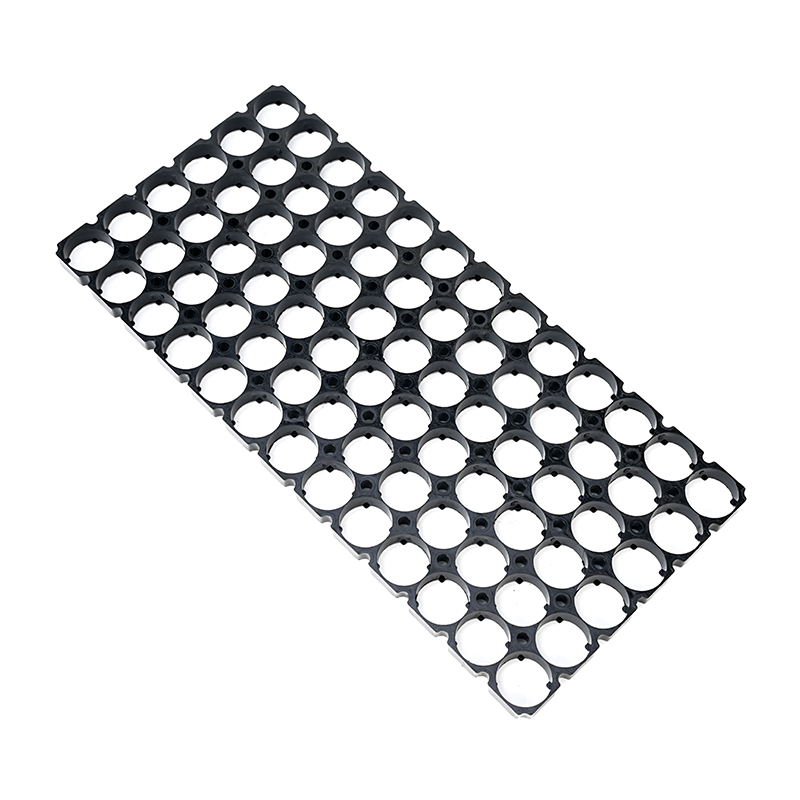
The 33140 9x16 Battery Cell Mounting Bracket is a precision-molded battery cell holder component designed to organize, position, and stabilize cylindrical 33140 battery cells in custom battery pack assemblies. As battery systems become increasingly compact, modular, and performance-oriented, reliable cell positioning has become an important part of battery pack mechanical design. A properly designed battery Cell Mounting Bracket helps maintain consistent cell spacing, improves structural stability, supports organized pack construction, and provides a practical foundation for assembling cylindrical cells into larger battery modules.
The 33140 9x16 configuration is intended for battery pack layouts containing 9 rows by 16 cell positions, providing a structured arrangement for cylindrical cells. The mounting bracket separates neighboring cells and helps maintain their intended relative positions during assembly, transportation, installation, and normal equipment operation.
A precision-molded structure ensures stable cell alignment and secure fitting. Instead of allowing cylindrical cells to move freely inside an enclosure, the bracket creates individual cell positions that help keep the cells organized. This is particularly valuable in applications where vibration, mechanical movement, repeated transportation, or compact packaging may otherwise cause cells to shift.
The modular design makes the holder convenient to assemble and disassemble. Depending on the battery pack construction, mounting brackets can be combined with additional holders, spacers, end plates, Insulation Materials, busbars, Nickel Strips, wiring components, protective housings, and battery management systems. This modular approach is suitable for both DIY battery projects and industrial battery packaging.
Another important characteristic is enhanced cell spacing. Maintaining uniform spacing between cylindrical cells can help create more predictable thermal and mechanical conditions throughout the battery assembly. Appropriate spacing may support heat dissipation pathways and reduce the possibility of unwanted contact between adjacent conductive components when the complete battery pack is correctly insulated and assembled.
The 33140 9x16 Battery Cell Mounting Bracket can be used in custom battery packs for e-bikes, electric mobility equipment, power tools, energy storage systems, portable power systems, backup power applications, laboratory battery projects, robotics, and other cylindrical-cell battery applications.
A battery cell mounting bracket is a mechanical component used to hold cylindrical battery cells in predetermined positions. It is sometimes described as a battery cell holder, battery cell spacer, cylindrical cell mounting frame, battery pack Cell Bracket, or cell positioning bracket.
The primary function is mechanical rather than electrical. The bracket does not replace electrical insulation, welding connections, a battery management system, thermal management components, or protective circuitry. Instead, it provides a physical framework that helps keep cells properly positioned while other battery pack components perform their respective functions.
The term 33140 generally refers to a cylindrical cell format associated with an approximate diameter and length class. However, exact cell dimensions can vary between manufacturers and cell constructions. Therefore, a mounting bracket should always be matched to the actual cell dimensions, tolerances, terminal configuration, and mechanical requirements of the intended battery cell.
The 9x16 designation describes a holder arrangement with 9 by 16 cell positions. Depending on the specific product design, the arrangement can represent a rectangular matrix containing multiple cylindrical cell locations. The actual assembled battery pack configuration should be verified before production because electrical series-parallel configuration, cell polarity orientation, insulation requirements, busbar layout, and enclosure dimensions are separate design considerations.
A high-quality battery cell mounting bracket is therefore more than a simple plastic frame. It is an important mechanical interface between individual cylindrical cells and the larger battery pack structure.
One of the key advantages of the 33140 9x16 Battery Cell Mounting Bracket is its precision-molded structure.
Precision molding allows the manufacturer to create repeated cell openings with relatively consistent dimensions and geometry. Consistency is important because cylindrical cells need to remain aligned throughout the battery pack. If individual cell positions vary significantly, the final assembly can become difficult to connect, insulate, or install inside an enclosure.
A precision-molded cell bracket can provide several mechanical benefits:
Stable cylindrical cell alignment
Consistent cell positioning
Reduced unwanted lateral movement
Organized battery pack construction
Repeatable assembly geometry
Improved compatibility with modular pack structures
Better control of cell-to-cell spacing
Cleaner routing space for associated components
The individual cell openings help guide the cells into their intended positions. This can simplify the assembly process because the installer does not need to manually maintain the position of every cell throughout the entire construction process.
Precision molding can also contribute to dimensional stability. When the holder is manufactured with suitable materials and tooling, the repeated openings can maintain their intended geometry under normal handling conditions.
However, dimensional accuracy should always be evaluated together with the actual cell dimensions. Battery cells may have manufacturing tolerances, protective sleeves, labels, insulating rings, terminal structures, or other surface features that affect the required holder opening.
For professional battery pack design, the holder should therefore be treated as one part of a dimensional stack-up that includes the battery cell, insulation sleeve, enclosure, spacers, busbars, wiring, thermal interface materials, and other components.
Cell alignment is a major consideration when assembling cylindrical battery packs.
Without a mechanical holder, cylindrical cells can rotate, slide, or move relative to neighboring cells. Such movement can make subsequent assembly operations more complicated. A cell mounting bracket provides defined positions that help maintain a consistent arrangement.
Stable alignment is particularly useful when a battery pack contains many cells. As the number of cells increases, small positioning errors can accumulate across the pack. A structured holder reduces this problem by establishing a repeatable geometric framework.
The 33140 9x16 Battery Cell Mounting Bracket can help keep cells aligned in a regular matrix. This can make it easier to plan:
Cell orientation
Insulation placement
Electrical connection routing
Busbar positioning
Nickel strip placement
Wiring pathways
Temperature sensor placement
Enclosure dimensions
Mechanical fastening
Service and inspection access
A stable arrangement can also improve the overall appearance and organization of a finished battery pack. For custom battery construction, this is valuable because a neat mechanical layout can simplify inspection and maintenance.
Secure fitting means that the cylindrical cell is retained sufficiently within its designated position under normal handling and assembly conditions.
A well-designed mounting bracket should hold the cell without unnecessarily damaging its outer surface. The balance between retention force and ease of assembly is important. If the opening is too loose, the cell may move excessively. If the opening is too tight, installation and removal may become difficult and the cell sleeve or outer surface could potentially be damaged.
The exact fitting characteristics depend on the cell diameter, holder material, molding tolerance, cell sleeve thickness, and holder geometry.
For this reason, users should verify actual dimensions rather than relying only on nominal cell format names.
Secure cell fitting is particularly valuable for:
Portable battery packs
E-bike battery assemblies
Power tool batteries
Energy storage modules
Robotics battery systems
Custom laboratory packs
Mobile power systems
Industrial battery enclosures
A mechanical holder can also help reduce movement during transportation. Nevertheless, it should not be considered a complete shipping protection system. Finished battery packs still require appropriate enclosure design, insulation, electrical protection, and packaging according to their intended application and applicable regulations.
The modular design of the 33140 9x16 Battery Cell Mounting Bracket makes it suitable for flexible battery pack construction.
A modular battery holder can be integrated with multiple mechanical and electrical components. Rather than designing every battery pack from scratch, engineers and DIY builders can use a standardized cell-positioning component as the foundation of a custom assembly.
Modularity can simplify:
Prototype development
Battery pack layout
Cell replacement
Mechanical assembly
Pack expansion
Inspection
Component integration
Production preparation
Maintenance
The ability to assemble and disassemble the holder can be particularly useful during prototyping. Designers can inspect cell positioning, test enclosure dimensions, evaluate cable routing, and adjust the battery architecture before finalizing the pack.
For industrial packaging, modular components can also help standardize production procedures. A repeatable holder geometry can provide a common mechanical reference for multiple battery pack configurations.
A practical cell mounting bracket should support efficient assembly.
The 33140 9x16 Battery Cell Mounting Bracket is designed around organized cell positioning, allowing cylindrical cells to be inserted into predefined locations. This can reduce the amount of manual alignment required during pack construction.
A modular holder may also be easier to remove during maintenance or prototyping. Depending on the complete battery pack design, the bracket can be combined with other holder sections or structural elements.
Easy assembly can be beneficial when building:
Prototype battery packs
Educational battery modules
DIY energy storage projects
Custom power stations
Robotics battery systems
Electric mobility batteries
Replacement battery assemblies
Small-batch battery modules
Disassembly should always be performed with appropriate electrical safety procedures. Battery cells can store substantial energy, and mechanical work around conductive terminals can create short-circuit hazards if suitable precautions are not followed.
Uniform cell spacing is another important design feature.
Cylindrical cells placed directly against one another may create an irregular mechanical arrangement. A structured holder creates defined positions between adjacent cells, supporting a more organized battery layout.
Consistent spacing can help with:
Mechanical stability
Thermal airflow pathways
Insulation placement
Electrical clearance
Inspection
Assembly consistency
Enclosure integration
Spacing should not be viewed as a substitute for an engineered thermal management system. Battery thermal behavior depends on cell chemistry, charge and discharge current, cell resistance, ambient conditions, enclosure design, heat transfer materials, airflow, cooling systems, and operating conditions.
However, an organized cell layout can make thermal management easier to design because the positions of the cells are predictable.
Battery cells generate heat during operation. The amount of heat depends on electrical current, internal resistance, ambient temperature, operating conditions, cell characteristics, and other factors.
The mounting bracket itself does not necessarily provide active cooling. Instead, the bracket can create a structured layout that helps preserve intended spacing and allows designers to plan thermal pathways.
Uniform spacing can be useful for:
Natural convection
Forced airflow
Thermal interface components
Cooling plates
Heat transfer structures
Temperature sensor placement
In larger energy storage systems, thermal management becomes increasingly important because many cells operate together. A well-organized cell matrix can make it easier to design a cooling strategy around the cells.
For high-current applications, the mounting bracket should be used as part of a complete thermal management design rather than treated as the only method of heat control.
The holder can contribute to safer mechanical organization by maintaining separation between adjacent cells and associated conductive components.
However, it is important to distinguish between mechanical spacing and electrical insulation.
A plastic cell mounting bracket can help physically separate cells, but it should not automatically be considered an electrical insulation barrier for every application. Battery packs may require additional Insulating Materials such as insulating paper, PET film, PC film, fish paper, insulating washers, terminal covers, Heat Shrink Tubing, adhesive insulation tape, or other engineered materials.
Short-circuit prevention should be addressed through the entire battery pack design.
Important considerations include:
Cell terminal insulation
Positive terminal protection
Nickel strip or busbar clearance
Welding quality
Insulation barriers
Wiring arrangement
BMS protection
Enclosure design
Mechanical impact protection
Correct polarity orientation
The 33140 9x16 Battery Cell Mounting Bracket supports mechanical separation and organized positioning, while electrical safety requires a broader system-level approach.
The bracket is particularly useful for custom battery pack development.
Custom battery systems often require a balance between available enclosure space, cell count, desired voltage, energy capacity, current requirements, thermal performance, and mechanical strength.
A standardized 9x16 cell arrangement can provide a repeatable mechanical starting point.
Potential applications include:
Custom lithium battery packs
E-bike battery systems
Power tool battery assemblies
Portable power stations
Energy storage systems
Robotics
Electric mobility equipment
Backup power systems
DIY battery projects
Experimental battery modules
Industrial equipment battery packs
The final electrical configuration should be designed according to the actual cell specifications and system requirements.
E-bikes are a common application for custom cylindrical battery packs.
An e-bike battery must accommodate vibration, movement, repeated charging and discharging, limited enclosure space, and mechanical installation requirements. Cell mounting brackets can help create an organized internal structure.
For an e-bike battery pack, a 33140 9x16 holder may help with:
Cell alignment
Pack organization
Mechanical stability
Space planning
Thermal pathway planning
Insulation arrangement
Enclosure integration
Because e-bike batteries may be exposed to vibration and outdoor operating conditions, the holder should be integrated with appropriate structural support and enclosure protection.
The complete battery system should also include suitable electrical protection, battery management, cell monitoring, charging control, and thermal considerations.
Power tools often require compact battery systems capable of delivering significant power.
A mounting bracket can help organize cylindrical cells inside a power tool battery housing. The structured layout may support consistent spacing and reduce mechanical movement.
Potential power tool applications include:
Cordless drills
Electric screwdrivers
Portable saws
Grinding tools
Outdoor power equipment
Workshop equipment
Portable industrial tools
The holder itself does not determine the electrical capability of the pack. Cell selection, series-parallel configuration, conductor size, welding quality, BMS design, thermal performance, and enclosure construction all influence the final battery system.
Energy storage systems often contain many battery cells arranged into modules.
In this environment, mechanical organization is particularly important because a larger number of cells creates more complex installation and maintenance requirements.
A 33140 9x16 Battery Cell Mounting Bracket can support a regular cell matrix and help establish a repeatable mechanical architecture.
Potential ESS uses include:
Residential energy storage
Backup battery modules
Solar energy storage
Portable energy storage
Small industrial energy systems
Laboratory storage systems
Off-grid power systems
Large-scale energy storage requires comprehensive engineering for thermal management, electrical protection, enclosure strength, fire safety, monitoring, and applicable regulations. The mounting bracket is one mechanical component within that broader system.
DIY battery builders often need flexible mechanical components that simplify cell arrangement.
A modular holder can make it easier to create an organized prototype without fabricating a custom cell frame from scratch.
Typical DIY applications may include:
Portable power projects
Robotics
Experimental energy systems
Custom lighting systems
Small electric vehicles
Educational battery models
Backup power projects
Electronic equipment power supplies
DIY builders should confirm cell specifications and use suitable protection systems. Battery assembly requires careful attention to polarity, insulation, electrical connections, charging, thermal conditions, and mechanical protection.
A battery pack is a system consisting of numerous components rather than only battery cells.
A typical cylindrical-cell battery pack may include:
Cylindrical battery cells
Cell mounting brackets
Insulating materials
Nickel strips or busbars
Battery management system
Temperature sensors
Wiring
Connectors
Enclosure
Cushioning materials
Thermal management components
Fasteners
Protective covers
The mounting bracket contributes to the mechanical organization of these components.
By establishing fixed cell positions, it can help designers create a predictable internal architecture.
Battery cell mounting brackets are commonly produced from engineered polymer materials selected for dimensional stability, mechanical strength, temperature resistance, electrical insulation characteristics, and manufacturability.
The exact material should be confirmed from the product specification before use in a particular application.
Common material considerations include:
Mechanical strength: The material should retain sufficient rigidity during assembly and normal handling.
Dimensional stability: The cell openings should maintain their intended geometry within the expected operating environment.
Heat resistance: The material should be compatible with the expected battery pack temperature range.
Electrical insulation: Where applicable, polymer materials can help provide mechanical separation, although additional insulation may still be required.
Impact resistance: Battery packs may experience vibration and mechanical shock, making structural durability important.
Processability: Injection molding and other production processes allow repeated holder geometries to be manufactured efficiently.
Dimensional stability is important because battery cells have relatively close mechanical relationships inside a compact pack.
A holder that changes shape significantly due to temperature, stress, or aging could affect cell positioning.
For this reason, material selection should consider:
Operating temperature
Storage temperature
Mechanical stress
Chemical exposure
Humidity
Long-term aging
Manufacturing tolerances
The actual performance depends on the material formulation and manufacturing process. Users should refer to the specific technical specification when exact temperature or mechanical ratings are required.
Before using a 33140 9x16 Battery Cell Mounting Bracket, users should verify compatibility with the intended cylindrical cell.
Important parameters include:
Cell diameter
Cell length
Cell sleeve thickness
Terminal configuration
Positive terminal geometry
Negative terminal geometry
Cell-to-cell clearance
Holder opening dimensions
Overall pack dimensions
The 33140 designation should not be treated as a universal guarantee of identical dimensions across every battery manufacturer.
A practical compatibility check should compare the actual cell dimensions with the holder's internal geometry.
Cylindrical battery cells can be arranged in different orientations depending on the pack design.
The holder can provide mechanical positioning, but the electrical polarity arrangement must be carefully planned.
Before assembly, designers should identify:
Positive terminals
Negative terminals
Series connections
Parallel connections
Busbar routes
Nickel strip routes
BMS sensing wires
Temperature sensor locations
The mounting bracket should support the intended physical layout without forcing incorrect electrical connections.
The 9x16 physical arrangement does not automatically define the electrical configuration.
A pack can contain different series and parallel arrangements depending on system voltage and capacity requirements.
For example, designers may define a battery configuration using a notation such as XsYp, where the first value represents the number of cells connected in series and the second represents the number of parallel cell groups.
The mounting bracket determines physical organization, while the electrical design determines:
Nominal voltage
Maximum voltage
Capacity
Current capability
Charging requirements
BMS requirements
The physical cell count should therefore be separated conceptually from the electrical configuration.
Nickel strips are frequently used in cylindrical battery pack construction for electrical interconnection.
A mounting bracket can help maintain cell positions while nickel strips are placed across cell terminals.
The holder can make the intended welding geometry easier to establish because the cells remain in predictable locations.
Important considerations include:
Strip width
Strip thickness
Material
Welding parameters
Current requirements
Terminal geometry
Insulation clearance
Mechanical stress
Nickel strip selection should be based on the required current and welding process rather than on physical appearance alone.
A battery management system, commonly called a BMS, monitors and protects battery cells or cell groups.
A mounting bracket does not replace a BMS.
Depending on the battery chemistry and application, a BMS may provide functions such as:
Overcharge protection
Over-discharge protection
Overcurrent protection
Short-circuit protection
Cell voltage monitoring
Temperature monitoring
Cell balancing
The mounting bracket can support organized physical placement of cells and provide a convenient mechanical structure around which BMS wiring and sensors can be arranged.
Temperature monitoring is an important part of many battery systems.
A structured cell matrix can make it easier to determine repeatable sensor locations.
Potential sensor positions may include:
Central cell areas
High-current regions
Areas near expected heat sources
Cooling inlet or outlet regions
Representative cells within the pack
Sensor placement should be determined by the actual thermal design. A holder does not automatically guarantee accurate temperature measurement.
Battery pack insulation may include several different materials.
Common materials include:
PET film
PC film
Fish paper
Aramid insulation paper
Insulating tape
Heat shrink tubing
Insulating washers
Adhesive foam
Electrical barrier films
The mounting bracket can coexist with these materials to create a more organized battery assembly.
In particular, terminal insulation is important because cylindrical cell terminals can create short-circuit hazards if conductive materials accidentally bridge adjacent terminals.
Battery packs used in mobile applications can experience continuous vibration.
E-bikes, power tools, robotics, vehicles, and portable equipment may all expose internal components to mechanical movement.
A mounting bracket can help restrict cell movement and establish a more stable internal structure.
However, vibration resistance is a property of the complete battery assembly. Other factors include:
Enclosure strength
Holder material
Cell fit
Cushioning
Fastening
Welding quality
Cable routing
External shock protection
For demanding applications, mechanical testing should be conducted under representative operating conditions.
Battery packs may experience accidental impacts during handling or operation.
A cell holder can provide some degree of mechanical organization, but it should not be considered a standalone impact protection device.
A complete design may use:
Rigid enclosure walls
Cushioning pads
Foam components
Cell holders
Protective plates
Insulating barriers
Mechanical fasteners
The purpose is to prevent excessive movement or direct mechanical damage to the cells.
A 9x16 arrangement provides a clearly defined rectangular cell matrix.
Potential advantages include:
Repeatable cell positioning
Efficient use of enclosure space
Easy cell counting
Predictable pack dimensions
Simplified mechanical planning
Organized wiring pathways
Convenient module construction
The exact dimensions of the completed pack depend on cell size, spacing, bracket thickness, external structure, insulation, and enclosure requirements.
Custom battery pack design usually begins with system requirements.
Designers may need to define:
Required voltage
Required capacity
Peak current
Continuous current
Cell chemistry
Cell dimensions
Number of cells
Physical enclosure
Thermal requirements
BMS requirements
Electrical connections
Mechanical protection
Once these requirements are known, the mounting bracket can be incorporated into the physical architecture.
The bracket can be especially useful during the prototype stage.
A prototype allows designers to evaluate:
Cell fit
Pack dimensions
Holder alignment
Electrical connection space
Wiring routes
Enclosure clearance
Cooling pathways
Sensor positions
Service access
Using a modular mounting component can reduce the need to fabricate a custom cell frame for every early prototype.
Industrial battery packaging requires repeatability and consistency.
A standardized mounting bracket can help create a common mechanical reference for multiple assemblies.
Potential benefits include:
Repeatable cell placement
Consistent production procedures
Easier quality inspection
Simplified component inventory
Reduced assembly variability
Easier prototype-to-production transition
For production applications, incoming inspection should verify the dimensional and material specifications of the holder.
Quality control for battery cell mounting brackets can include dimensional inspection and visual inspection.
Important inspection points may include:
Overall dimensions
Cell opening dimensions
Opening consistency
Warping
Cracks
Burrs
Surface defects
Material integrity
Alignment
Connection features
A damaged holder should not be used if its condition could affect cell positioning or insulation.
Proper storage of polymer mounting brackets can help preserve product quality.
Storage conditions should generally avoid unnecessary exposure to:
Excessive heat
Direct sunlight
High humidity
Aggressive chemicals
Mechanical deformation
Heavy loads
The exact storage requirements depend on the holder material.
During handling, users should avoid bending or crushing the bracket, particularly before installation.
Before installation, inspect both the battery cells and the holder.
Verify:
Cell dimensions
Holder dimensions
Cell sleeve condition
Terminal insulation
Holder integrity
Cell polarity
Intended cell arrangement
Cells should be inserted carefully without excessive force.
The holder should sit correctly within the intended enclosure or structural assembly.
For serviceable battery systems, the holder can simplify inspection by keeping cells in an organized configuration.
Maintenance inspections may include:
Cell movement
Holder cracks
Deformation
Insulation damage
Loose electrical connections
Wiring damage
Signs of overheating
Enclosure damage
Any battery pack showing abnormal heating, swelling, leakage, smoke, damaged cells, or other dangerous symptoms should be removed from service and handled according to appropriate battery safety procedures.
The holder provides structured cell organization for compact electric mobility battery assemblies. Its modular design can support enclosure integration and cell alignment.
The bracket can help maintain organized cylindrical cell placement in compact power tool battery housings.
The holder can provide a repeatable cell arrangement for modular energy storage assemblies.
The mounting structure can simplify prototyping and custom battery pack construction.
A stable cell arrangement can help reduce unwanted cell movement in mobile robotic platforms.
The holder can support organized internal construction in portable power systems where compact packaging is important.
Cell spacing affects more than physical appearance.
Proper spacing can contribute to:
Mechanical clearance
Thermal planning
Electrical insulation
Inspection access
Manufacturing consistency
Pack serviceability
When many cells are assembled together, consistent spacing helps create a predictable system geometry.
However, spacing should always be evaluated alongside the actual thermal and electrical requirements of the application.
One of the most important concepts when using a battery cell mounting bracket is understanding the difference between mechanical and electrical functions.
The bracket primarily performs mechanical functions:
Positioning
Alignment
Separation
Retention
Structural organization
Other components perform electrical functions:
Nickel strips
Busbars
Wires
Connectors
BMS
Fuses
Charging circuits
Insulation components perform electrical isolation functions.
Thermal components perform heat management functions.
A safe battery pack combines all of these functions into a coordinated design.
A modular cell mounting bracket can provide several production advantages.
It can support:
Standardized assembly
Faster cell placement
Repeatable pack geometry
Easier inspection
Better internal organization
Simplified prototype development
Flexible battery configurations
Manufacturers can integrate the bracket into assembly procedures based on their own production methods and quality requirements.
DIY battery builders can benefit from the reduced need to fabricate custom cell positioning structures.
A ready-made 9x16 mounting configuration can provide a convenient starting point for battery pack layout.
It can help builders focus on:
Cell selection
Electrical architecture
BMS integration
Enclosure design
Thermal management
Wiring
Insulation
The holder therefore functions as a mechanical foundation rather than a complete battery solution.
The 33140 9x16 Battery Cell Mounting Bracket is a precision-molded cylindrical battery cell holder designed for organized and stable battery pack assembly. Its 9x16 cell arrangement provides structured positioning for compatible 33140 cylindrical battery cells while maintaining consistent spacing between neighboring cells.
With a precision-molded structure, the battery cell mounting bracket helps ensure stable cell alignment and secure fitting. The modular design allows convenient assembly and disassembly, making it suitable for DIY battery projects, prototype development, custom battery packs, and industrial battery packaging.
Uniform cell spacing supports organized pack construction and can help facilitate planned heat dissipation pathways. The holder also helps reduce unwanted cell movement and contributes to mechanical separation between neighboring cells. When combined with suitable insulation materials and electrical protection components, it can form part of a well-organized cylindrical battery pack structure.
The 33140 9x16 Battery Cell Mounting Bracket is suitable for a wide range of custom battery applications, including e-bikes, power tools, energy storage systems, portable power equipment, robotics, electric mobility systems, and DIY battery projects.
The precision-molded structure creates consistent cylindrical cell positions for stable alignment and secure fitting. Accurate cell positioning is especially valuable for multi-cell battery assemblies where small mechanical errors can accumulate across the pack.
The modular design supports flexible battery pack development. It can be integrated with compatible cell holders, insulation materials, electrical interconnects, enclosures, and other battery components.
The bracket maintains defined separation between cell positions. This organized spacing can support thermal planning, electrical clearance, mechanical stability, and easier assembly.
The individual cell locations help restrict unnecessary cell movement and maintain the intended battery matrix.
The 9x16 format is suitable for custom battery pack layouts where a structured cylindrical cell arrangement is required.
The modular construction can simplify prototype and DIY battery pack assembly by providing a ready-made mechanical cell positioning framework.
For industrial battery packaging, repeatable holder geometry can contribute to standardized assembly and consistent internal pack construction.
The following information represents general specification categories that should be confirmed against the actual product drawing or technical datasheet before production use.
Product type: 33140 cylindrical battery cell mounting bracket
Cell arrangement: 9x16
Application: Cylindrical battery pack assembly
Primary function: Cell positioning and mechanical separation
Design: Precision-molded modular structure
Assembly: Designed for convenient cell insertion and modular integration
Typical applications: E-bike batteries, power tools, ESS, portable power, robotics, custom battery packs, DIY battery projects
Material: Engineering polymer or other suitable molded insulating material, depending on product specification
Color: Product-dependent
Cell compatibility: Compatible with specified 33140 cylindrical cell dimensions
Electrical function: Primarily mechanical; additional electrical insulation and protection may be required
Thermal function: Supports organized spacing and thermal pathway planning; not a standalone cooling system
Customization: Physical and material options may vary by production requirements
A practical battery pack design process can follow several stages.
Measure or verify the actual diameter and length of the selected 33140 cells.
Compare cell dimensions with the mounting bracket openings and retention geometry.
Determine the required physical number and orientation of cells.
Determine the series and parallel arrangement based on system voltage and capacity requirements.
Identify all areas requiring electrical isolation.
Determine nickel strip, busbar, cable, connector, and BMS routing.
Evaluate expected heat generation and determine whether natural or forced cooling is required.
Verify clearance between the holder, cells, insulation, wiring, and enclosure walls.
Evaluate movement, vibration, impact, and fastening requirements.
Conduct appropriate electrical, thermal, mechanical, and safety testing before deployment.
It is a molded mechanical holder designed to organize compatible 33140 cylindrical battery cells in a 9x16 arrangement.
It generally refers to a holder layout containing 9 by 16 cell positions. The exact physical dimensions depend on the specific holder design.
Yes. Its modular cell positioning design makes it suitable for many DIY and prototype battery pack applications, provided the holder is compatible with the selected cells.
It can be used as a mechanical cell-positioning component in compatible e-bike battery designs.
It may be suitable for power tool battery assemblies when the cell format, enclosure dimensions, electrical configuration, and thermal requirements are compatible.
Yes, the holder can be integrated into appropriate energy storage battery modules. Larger ESS applications require comprehensive thermal, electrical, mechanical, and safety engineering.
The holder can help maintain physical separation and organized cell spacing, but it should not be considered the sole short-circuit protection mechanism. Proper insulation and electrical protection are still required.
The holder does not necessarily provide active cooling. Its organized spacing can support thermal pathway planning and heat dissipation design.
Battery cell mounting brackets are commonly produced from polymeric materials, but the exact material must be confirmed from the product specification.
Customization depends on the manufacturer and production process. Possible customization areas may include dimensions, cell arrangement, material, color, and structural geometry.
Selecting the correct holder requires more than matching a product name.
Users should evaluate:
Actual cell dimensions
Number of cells
Cell arrangement
Holder opening size
Retention requirements
Operating temperature
Mechanical vibration
Enclosure dimensions
Insulation requirements
Electrical connection layout
Thermal management
Manufacturing process
A holder that fits one cylindrical cell format may not fit another format even if the nominal dimensions appear similar.
Battery assembly should be approached as an engineered electrical and mechanical system.
Important safety principles include:
Do not reverse cell polarity.
Do not use visibly damaged cells.
Do not create uncontrolled conductive paths.
Protect exposed terminals.
Use appropriate insulation.
Use suitable electrical protection.
Avoid excessive mechanical pressure on cells.
Control welding parameters.
Monitor temperature where appropriate.
Use a suitable BMS when required.
Verify charging requirements.
Protect the completed pack inside an appropriate enclosure.
The mounting bracket contributes to mechanical organization but does not replace these safety measures.
Battery mounting components may be exposed to different environmental conditions depending on the application.
Consider:
Temperature
Humidity
Dust
Vibration
Shock
Chemical exposure
UV exposure
Long-term aging
For outdoor equipment such as e-bikes, environmental protection should be provided by the complete enclosure and sealing system.
A battery cell mounting bracket can help stabilize cells inside a battery assembly, but the complete battery pack still requires appropriate transportation packaging.
The finished battery should be protected against:
Mechanical impact
Excessive vibration
Terminal contact
Moisture
Contamination
Unintended activation
Short circuits
Transportation requirements vary according to battery chemistry, configuration, capacity, jurisdiction, and applicable regulations.
Long-term battery pack reliability depends on the interaction between cells, holder, insulation, electrical connections, enclosure, thermal environment, and operating conditions.
A reliable mechanical design should minimize:
Cell movement
Excessive mechanical stress
Contact damage
Insulation abrasion
Uncontrolled thermal accumulation
Wiring strain
A precision-molded holder can contribute to reliability by providing a repeatable physical structure.
The main advantages of the 33140 9x16 Battery Cell Mounting Bracket can be summarized as follows:
Precision-molded structure
Stable cylindrical cell alignment
Secure cell fitting
Modular construction
Easy assembly
Easy disassembly
Uniform cell spacing
Organized battery pack architecture
Support for thermal pathway planning
Mechanical separation between cell positions
Suitable for custom battery packs
Suitable for DIY projects
Useful for industrial battery packaging
Compatible with a wide range of battery system designs when dimensions are matched
Suitable for e-bike, power tool, ESS, robotics, and portable power applications
The 33140 9x16 Battery Cell Mounting Bracket provides a practical mechanical foundation for organized cylindrical battery pack construction. Its precision-molded structure helps maintain stable cell alignment and secure fitting, while the modular design makes assembly and disassembly more convenient for both prototype and production applications.
Uniform cell spacing is another important benefit. By establishing defined positions between neighboring cylindrical cells, the holder supports a more organized battery architecture and can facilitate planned thermal pathways, insulation placement, wiring organization, and enclosure integration.
The holder is particularly suitable for custom battery packs used in e-bikes, power tools, energy storage systems, portable power equipment, robotics, electric mobility products, and DIY battery projects.
For professional battery pack development, the mounting bracket should always be considered as one component of the complete system. Cell dimensions, electrical configuration, insulation, welding, BMS protection, thermal management, enclosure design, mechanical strength, and applicable safety requirements must all be evaluated together.
When correctly matched to the intended 33140 cylindrical cells, the 9x16 mounting configuration can provide a repeatable and organized mechanical structure for multi-cell battery assemblies. Its combination of precision molding, modular construction, stable cell alignment, secure fitting, and controlled spacing makes it a useful component for modern custom cylindrical battery pack designs.
This website uses cookies to ensure you get the best experience on our website.



 Phone
Phone